
Today I’m going to write something that will probably cost me readers.
I know it, and I’m writing it anyway. I’ve been turning it over for years and I never find the clean moment to say it, so I’ll say it now, without dressing it up.
I want to talk about the monopoly of violence.
Think about how it all began. We were born to be free over the world, like any animal that opens its eyes without asking anyone’s permission. But fear is heavy. And over time people huddled together, first to defend themselves, then to farm, then simply because being together was easier than facing the night alone.
In every group, someone emerged as the one in charge. Someone who protected. And someone who protects ends up, sooner or later, deciding who to attack.
That’s how it went. One village took what another had stored. The winner grew stronger. The strongest won again. And the one who led those conquests was almost always the same man they’d appointed to keep them safe.
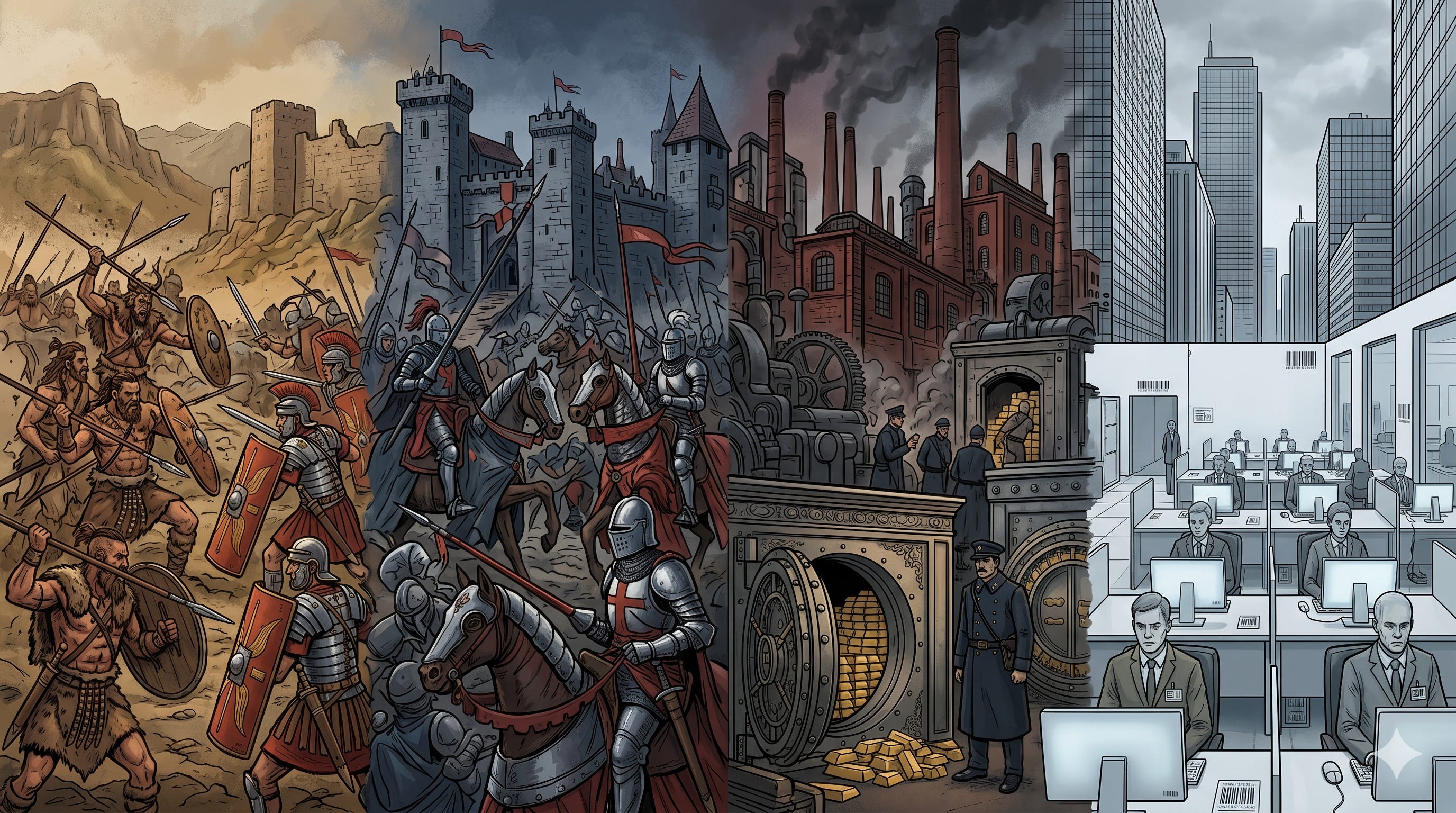
Rome, feudalism, empires. The mechanics never changed. They only scaled.
What did change was the spoils. At some point food stopped making sense as a target: it rotted, it didn’t last, it was useless for accumulating power over time. Then came gold. Something that didn’t spoil. Something that lasted, almost infinitely.
And here’s the detail few people look at straight on.
Whoever controlled the gold could pay for his own defense. He could pay soldiers. And with those soldiers he could force everyone beneath him to pay him too. Money bought violence, and violence guaranteed the money.
A closed loop.
There’s a question that won’t leave me alone: what would have happened if those soldiers hadn’t been bought with money?
Because in the end that’s what they were. Not an idea, not a homeland. A group of people insuring one another in exchange for incentives. Land promised. Gold promised. Favors.
Take money out of the equation and the whole thing wobbles. With no gold to buy loyalty, power could only have offered favors. Maybe there would have been small skirmishes, the law of the strongest on a small scale, a more chaotic world.
I’m not sure it would have been worse.
Sometimes I suspect that honest chaos is less violent than financed order. Because financed order has a capacity that the guerrilla never had: the ability to sustain itself over time, refine itself, and become invisible.
And that’s the part that truly unsettles me.
Today the monopoly of violence is no longer visible. There are no soldiers at your door. There’s something cleaner and more efficient: the tax.
It’s easy to impose on private property, because property doesn’t move and neither do you. If taxes go up, you stay quiet. If you leave the country, you pay for leaving. If you have a lot, you pay for having. If you spend, you pay for spending. If you donate, you pay for donating. If you inherit, you pay for dying.
You pay for every verb of your life.
And behind each of those payments, if you scratch the surface, the same thing is still there that stood behind Rome. Violence. Polished, bureaucratized, dressed in legitimacy, but violence all the same. Whoever doesn’t pay finds that out quickly.
I don’t write this from resentment. I pay what I’m asked and I sleep fine. I write it because I think you have to see things as they are before you decide what to do with them. And what I see is this: we were born to be free over the world, and the first thing the world did was draw borders around us.
Not to protect us.
To fence us in. To know where we are, how much we have, and how much can be demanded of us before we leave.
The border isn’t a wall against the outsider. It’s an enclosure for the one inside.
So the question I keep asking myself, the only one that really matters, is this: how do you live as free as possible inside a system designed for you not to be? How do you avoid the abuse without becoming a martyr, without fleeing, without breaking anything?
I have an answer.
But I’m not giving it today. I’ve thought about it for years and it deserves its own space, not a rushed line at the end of this piece.
Until then, sit with the discomfort. It’s more useful than it looks.
Agreed I think we all live in a guilded cage of societies making and school and the state help continue it and want to turn us all into compliant workers and payers