

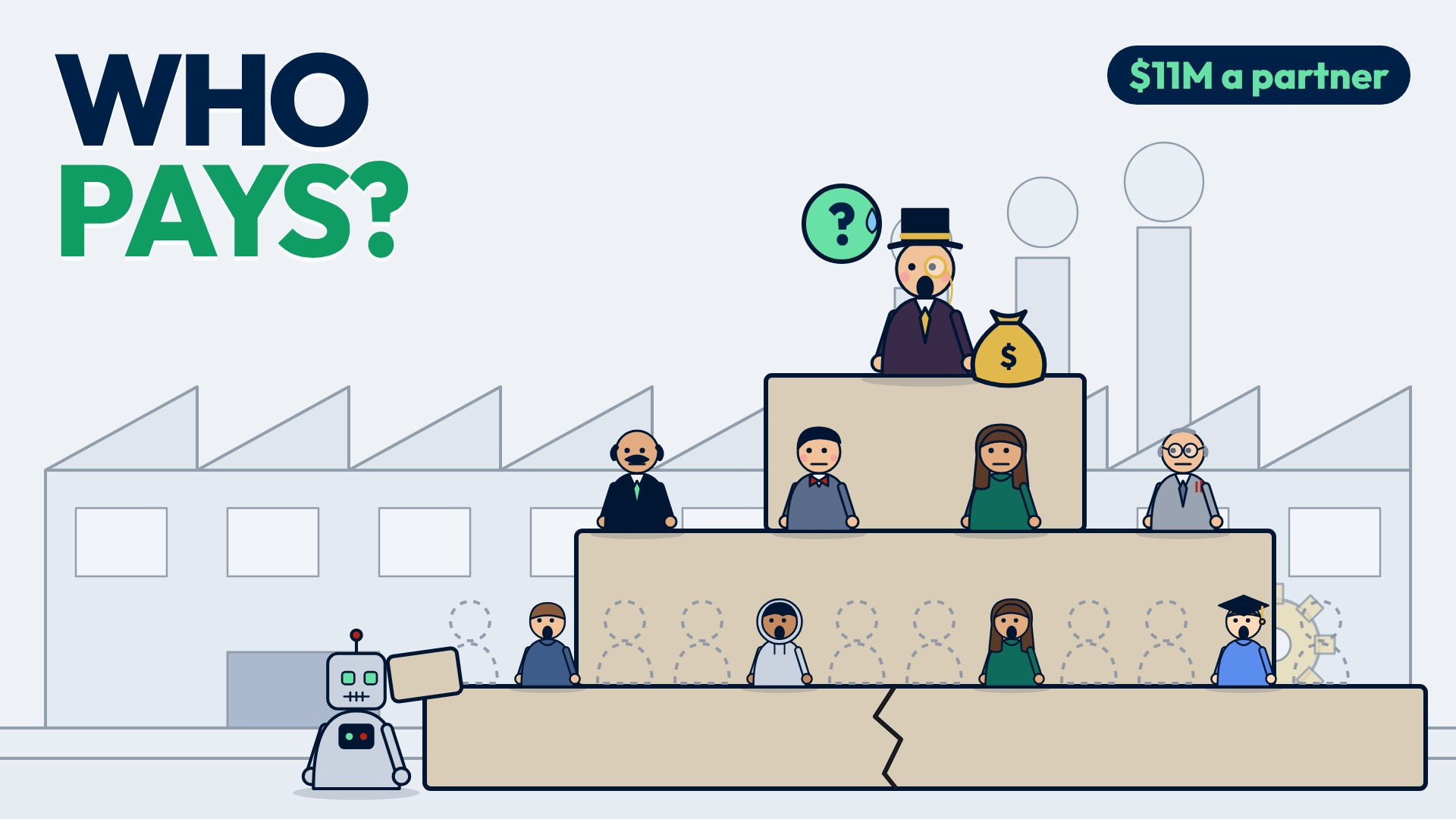
Every spring a number gets published that almost nobody outside the industry bothers to read: profit per partner. This year Kirkland & Ellis, the biggest law firm in the world, paid out $11 million per equity partner. The big audit firms in the UK, somewhere around a million pounds. People read those numbers as success stories. Read them differently.
A partner at a big firm doesn’t sell his time. He sells other people’s time, with a margin on top. There’s a line that gets repeated in those corridors, half as a joke: my job is to keep thirty people busy so I get paid. It isn’t a joke. It’s the most honest description of the model anyone has ever given.
And AI has just started producing those hours for free.
Let’s do the maths without dressing it up. A typical practice in consulting, audit or law looks roughly like this:
1 partner, taking home around €1,000,000. Deloitte UK’s average partner payout crossed £1m in 2025. KPMG UK, £816,000.
4 managers or directors, at €100,000–150,000 each.
12 consultants and analysts, at €35,000–60,000 each.
Revenue needed to make it all work: €4–5 million. The partner personally generates maybe 10% of that with his own hours. The other 90% comes from the sixteen people underneath him.
The partner doesn’t live off his talent. He lives off leverage: twelve people billed at €900 a day and paid €200.
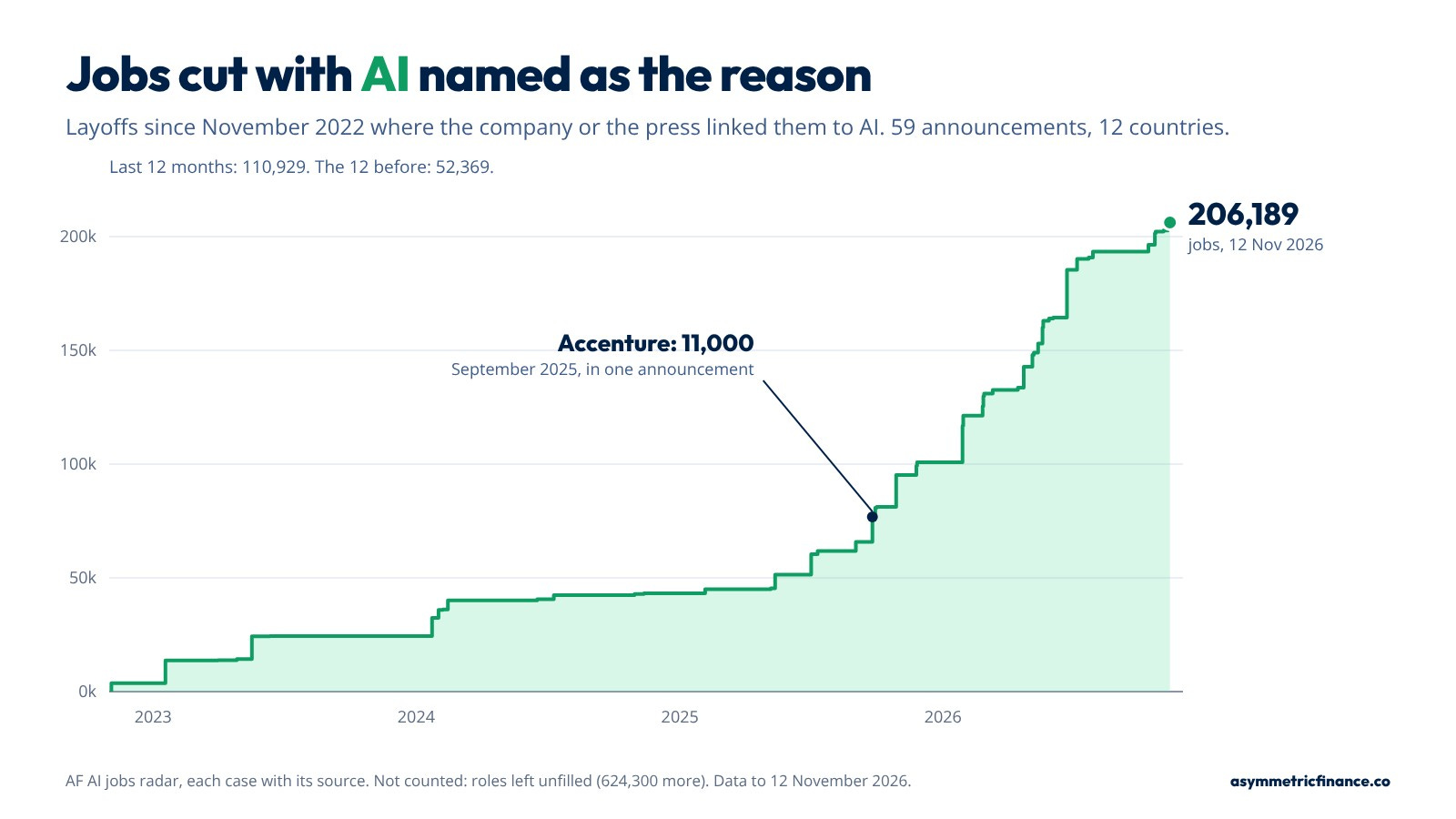
Now take eight of those twelve away. Not because the firm wants to, but because the client already knows a model does in two hours what used to take an analyst three weeks. The firms know it too. The Big Four in the UK cut graduate intake by up to 29% in two years. McKinsey went from over 45,000 people to around 40,000 and then announced another 10%. Accenture dropped 11,000 jobs in a single quarter.
Run the numbers again:
1 partner who still expects €1,000,000.
4 managers.
4 consultants, with AI, producing what the previous twelve did.
Revenue: the client wants a discount, because the work now costs less to produce. Call it €3 million instead of €4.5.
The margin on other people’s hours is gone. The partner has three options. None of them are good.
The first option is the one already happening: protect the payout per partner at everyone else’s expense. In 2025 the UK Big Four admitted 179 new partners between them, the lowest in five years. Deloitte went from 124 promotions in 2022 to 60. Fewer people get into the pool so the ones already in it get more water. At the same time, the “salaried partner” title is spreading: the name on the door, not on the deed.
The second option is to sell more. And here’s the irony nobody wants to say out loud: what these firms sell most of right now is AI. Accenture booked $3.6 billion of AI work last year. BCG says a quarter of its revenue comes from it. They are charging clients to install the machine that destroys their own pricing model. It’s the best business in the world while it lasts. It lasts exactly until the client learns to install it alone.
The third option is the one that turns the pyramid into something worse.
Think about what a partnership actually is. You get in with a loan from the firm itself to buy your share. You take an annual distribution that depends on the firm continuing to grow. And when you retire, at many firms your partner pension isn’t sitting in a fund. It’s paid by the partners still working, out of that year’s profits. Nobody saved for you. The next ones pay.
There’s a word for that. A system where the current participants are paid with the contributions of future participants, and which only works as long as people keep entering at the bottom, is not a company. It’s a chain. And every chain fails at the same point: the day the people at the bottom stop coming in.
AI is that day. Not because it fires partners. Because it removes the reason the lower levels existed, and with them the source of the future payments. When a firm cuts junior intake by 30%, it isn’t trimming costs. It’s closing the tap that was supposed to pay today’s partners their pensions fifteen years from now.
This isn’t a consulting problem. It’s the problem of any business whose only way to grow was to hire more people. Kirkland has 595 equity partners on $11 million each, and 1,228 non-equity partners producing the margin for them. The non-equity tier grew 11% last year; the equity tier, 4%. Elite law is no longer a pyramid. It’s a pyramid with another pyramid on top. Ad agencies billing by headcount. Indian outsourcers who’ve spent thirty years selling arms. Headhunters. Translation shops. Architecture studios. Every business where the product, underneath, was busy people.
Here’s the reading that matters for us.
A partner’s income looks like capital income. It’s called a profit share, there are units, there’s a buy-in. But it isn’t capital. You can’t sell it. It has no terminal value. It disappears the day you stop working. It’s tied to one firm, one country, one tax regime and one pyramid that is already being dismantled. It’s a very large salary dressed up as ownership, with a lien held by the system.
What AI is doing is what Naval spent years saying: separating income from time. And in that separation, the person who was paid to manage other people’s time is just as exposed as the person selling it. Maybe more. The one at the bottom can reinvent himself at thirty. The partner, with the house, the school fees and the buy-in loan, can’t.
The question isn’t whether you work in professional services. It’s which side of the equation you’re on. If your income depends on other people producing hours, you have a horizon problem that no promotion fixes. If your income depends on assets that don’t need anyone to clock in, AI doesn’t destroy you. It makes everything else cheaper.
I know which side I’m on.