
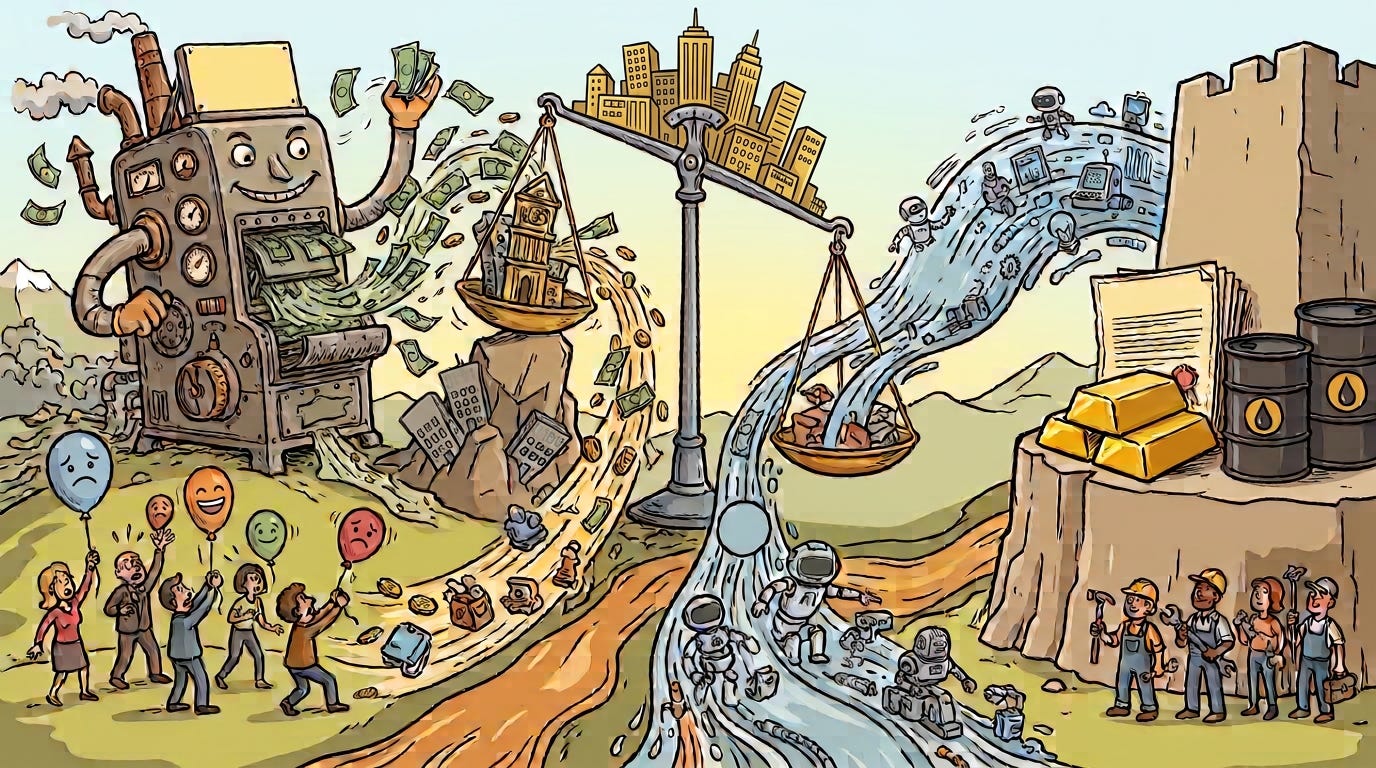
There’s a line Hayek wrote in 1928 that I keep going back to.
He said that stabilising prices while manufacturing costs are falling amounts to over-stimulating production, and that the eventual fall in prices, together with a simultaneous contraction of output, becomes unavoidable.
He wrote it one year before the crash.

I don’t think I need to explain why it keeps coming back to me.
I’ve been writing for a while now that AI is going to be the Trojan horse for robotisation, that the productivity jump heading our way has no recent precedent, that people are already talking about billion-dollar companies run by a single person while physical work (the real kind, the kind that moves things) still needs a lot of hands and survives on thin margins.
Worth being precise here, because this stat gets repeated badly. The billion-dollar one-person company doesn’t exist yet. It’s a projection of Altman’s, not a fact. What does exist is the trajectory, teams of twenty people billing hundreds of millions, revenue-per-employee ratios that were impossible ten years ago. The direction is unmistakable, the headline isn’t there yet.
But that isn’t the question that matters.
The question is whether any of this has happened before, and it has, several times.
The clean example isn’t “after the industrial revolution” in general, because that period is contaminated by the Napoleonic wars and the inflation they brought. The clean example is 1873 to 1896, the Great Deflation, nearly a quarter of a century with prices falling one or two percent a year while real output grew hard, railways and electricity reorganised the entire economy, and real wages rose.
Prices down, wealth up.
That’s the part people don’t get, because they’ve been taught that deflation is a synonym for disaster.
In a capitalist economy with continuous productivity gains, consumer prices have a natural tendency to fall. It isn’t an anomaly, it’s the mechanism working properly, your purchasing power capturing technological improvement without asking anyone’s permission.
Hayek went further than that. He argued that in an expanding economy money is only neutral if prices decline, and that a falling price level driven by continuous improvements in production isn’t merely harmless, it’s necessary if you want to avoid imbalances.
That is precisely what a central bank works against, every day, by mandate.
Now the uncomfortable part, which is where I have to sharpen my own thesis.
1929 was not a deflationary blowout caused by technology.