Let me tell you something that actually happened.
Not a parable. Not a thought experiment dressed up as history. A real country, real people, real numbers you can still look up. Germany, the autumn of 1923. I want you to sit inside it for a minute, because almost everything you believe about money is hiding in this single episode, and almost no one who lives through their own version of it ever notices.
By the autumn of 1923, the German mark had stopped being money in any meaningful sense. Prices were not rising. They were detonating. A loaf of bread that cost a couple of marks before the war cost hundreds of billions by November. Workers were paid twice a day and ran to spend it at noon, because by evening the same wage bought half as much. People burned banknotes for warmth, because the paper was worth less than the firewood it could buy. Cafés posted prices that changed between the order and the bill. An entire society watched, in real time, the destruction of the thing it had spent its whole life accumulating.
This was not bad luck. It was the end of a chain that began years earlier. Germany had financed a war on credit, lost it, and then been handed a reparations bill it could not pay. The government did the only thing a government in that position ever does. It printed. And once you start printing to cover a hole that keeps growing, the printing itself becomes the hole. The currency entered the spiral that takes it to zero.
Now hold onto one detail, because it matters more than all the rest.
Before the war, Germany had roughly 1.5 billion dollars’ worth of currency in circulation, sitting on top of just under a billion dollars in gold. Not full backing, but a real anchor. Five years later, after the war, the reparations, and the collapse, the gold reserve had fallen to under 150 million dollars. The anchor was gone. And the little gold that remained sat inside the Reichsbank, whose president, Rudolf von Havenstein, refused to part with a single ounce. He would not pledge what he could not control.
So picture the problem honestly. The country needs a new currency. Everyone agrees the only serious anchor is gold. And there is no gold.
Into this walked a man named Hjalmar Schacht, and his solution is where the real lesson lives.
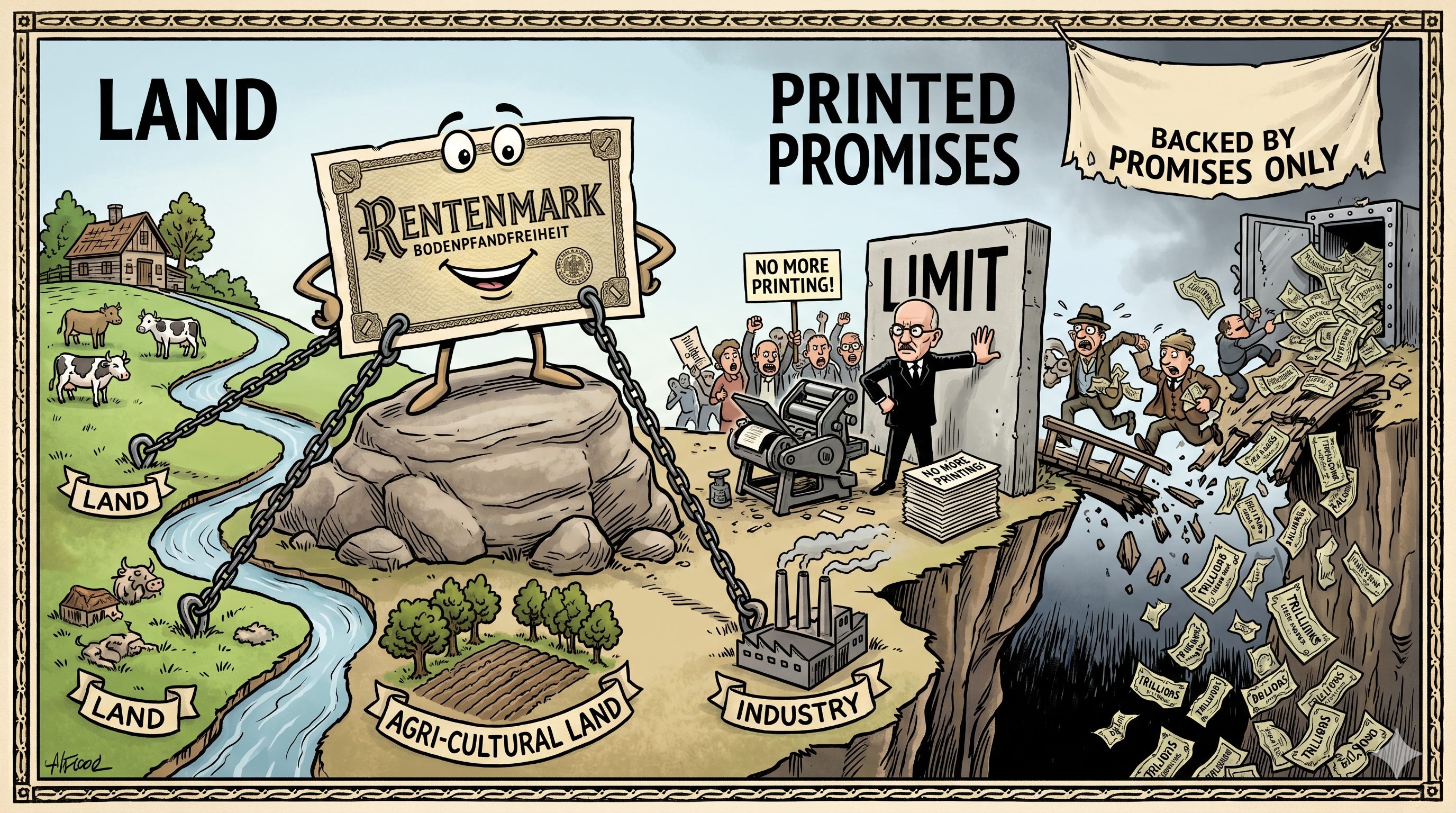
The plan they reached for was a new currency called the Rentenmark, and it would be backed (officially, on paper) not by gold, but by land. The issuing bank would hold a kind of mortgage over the country’s farmland and industry, with the right to levy an annual charge of around five percent on it. In effect, a tax on real estate, dressed up as collateral. Every new banknote was, in theory, a claim on a slice of German soil.
Schacht thought this was nonsense, and he was right.
He understood, better than almost anyone, that no ordinary German was going to feel reassured by the theoretical promise that his banknote was ultimately convertible into an inaccessible forest somewhere in Thuringia, a pasture in Bavaria, or a factory in the Saar he would never set foot in. You cannot eat a promise. You cannot spend a mortgage on a field you will never see. The land backing was theater. A story to make the medicine go down.
And yet the Rentenmark worked. The hyperinflation stopped, almost overnight. The currency held. Confidence returned.
This is the exact point where the entire world learns the wrong lesson.
The lesson everyone takes home is comforting and false: money needs backing, and the backing restored trust. Generations of people repeat this without ever examining it. But the land never backed anything. Not one holder of Rentenmarks ever walked into a bank and claimed his hectare of Bavaria. The collateral was decoration.
What actually saved the currency was a single, brutal number.
The total amount of Rentenmarks that would ever be issued was capped at 2.4 billion, roughly 600 million dollars. And Schacht turned that cap into a religion. He understood that the only thing standing between the new money and the same death the old money had just suffered was a credible promise that there would be no more. So he refused. He refused credit to government ministries, to municipalities, to banks, to the great industrialists, to his own colleagues in the cabinet. He was stubborn to the point of cruelty, and the cruelty was the point.
It was never the land. It was never even the gold. It was the limit.
This is the reflection almost no one makes in their entire life. And it is the one that, once you make it, quietly rearranges how you see everything.
Here it is.
Every time you measure the value of something, you are reading a fraction. There is a number on top and a number on the bottom. And you have spent your whole life staring at the top while assuming the bottom is fixed.
The S&P in dollars (S&P500/USD). Your house in euros (house/EUR). Bitcoin in dollars (BTC/USD). Your salary, your net worth, your portfolio, all of it is a ratio. A numerator over a denominator. And the denominator is the unit you measure in: the dollar, the euro, the currency you happen to live inside.
You watch the numerator rise. You feel richer. You celebrate. And in that moment you are making an enormous, invisible assumption: that the ruler hasn’t changed. That a dollar today measures the same distance a dollar measured a decade ago.
It doesn’t. The ruler is shrinking.
A large part of what you proudly call “returns” is not your asset growing. It is your unit of measurement dying. You are measuring a distance with a tape measure that gets a little shorter every night, and you are congratulating yourself because the number keeps going up. Of course the number goes up. That is the entire function of a debasing denominator: to rise just enough, just slowly enough, that you never quite notice you are standing still or sinking.
Nobody teaches you to ask about the bottom of the fraction. Think about it. A master’s degree in corporate valuation will train you to calculate the numerator with obsessive precision, discounted cash flows, multiples, a weighted cost of capital measured to the third decimal, while leaving you completely blind to the denominator that the whole calculation floats on. You learn to measure exquisitely, on a ruler made of rubber.
This is why the history of money is worth more than any of those degrees. It does not teach you to count better. It teaches you what you are counting. And what you are counting, almost always, is your own dilution.
Once you make that reflection, the question you ask about any asset changes completely. You stop asking “what is it worth?” and start asking the only question that has ever mattered:
Who can create more of this, and how fast?
That single question is the entire history of money, compressed. Gold worked for thousands of years not because the metal is magical, but because no one could conjure it into existence. You can dig, refine, and bleed for a little more each year, and even then the supply crawls forward at a glacial pace. Gold was never really a “backing.” It was a limit, wearing the costume of a metal. Its value came from the one thing no committee could override: scarcity that nature itself enforced.
The dollar has no forest in Thuringia behind it. It has a committee that decides how much exists. So does the euro. So does every modern currency. They all share the same invisible backing not gold, not land, but a promise: that whoever issues them will restrain themselves. It is, precisely, the Rentenmark mechanism with the stage set removed. Faith in a limit that a human being has promised to honor.
The difference is that the limit is gone now. They erased it. There is no cap. There is no Schacht in the room at three in the morning, refusing the industrialists. There is only the printer and the political incentive to keep using it, because inflation is the only way a state buried in debt can quietly default on its own citizens without ever admitting it.
And this is where your portfolio stops being an opinion and becomes arithmetic.
If the denominator is designed to shrink, then real ownership is not a claim denominated in that denominator. A share priced in a debasing currency is not, in the deepest sense, property. It is a loan to a system that reserves the right to change the ruler whenever it needs to. A bond is that system’s promise. Cash itself is a short position on the discipline of a committee that has none.
Real ownership is something else. It is holding the thing whose quantity is fixed by mathematics rather than by politics. Gold, because geology caps the speed. Bitcoin, because the code caps the total at twenty-one million and there is no obstinate man who has to find the courage to say no, the refusal is written into the protocol. The Rentenmark depended on the willpower of one stubborn human being who could have caved under pressure, and eventually the discipline of the system did fade. Bitcoin removes the human entirely. The limit cannot get tired. It cannot be bribed. It cannot be voted away in an election year.
This is what actually makes a portfolio asymmetric. Not concentration. Not leverage. The conscious choice of the denominator.
You build on the things that cannot be diluted. You borrow against them in the currency that can. And you let time work in the direction of the fraction. Long scarcity, short the rubber ruler. That is the position. Everything else is a footnote.
The German of 1923 learned this the hard way. He watched his entire numerator, every mark he had ever earned and saved, fall to zero, not because the world ran out of value, but because someone broke the limit. And then he clung to a new currency, not because there was land behind it, but because, for once, someone made a credible promise to create no more.
A hundred years later, we are all still living inside that same promise. The only difference is that no one keeps it anymore.
You don’t have to wait for them to keep it. You can step out of the denominator. You can own the limit itself.
And once you’ve seen the fraction for what it is, you can never unsee it again.


