How to Escape the New Tax Regime Legally
The New Wealth War
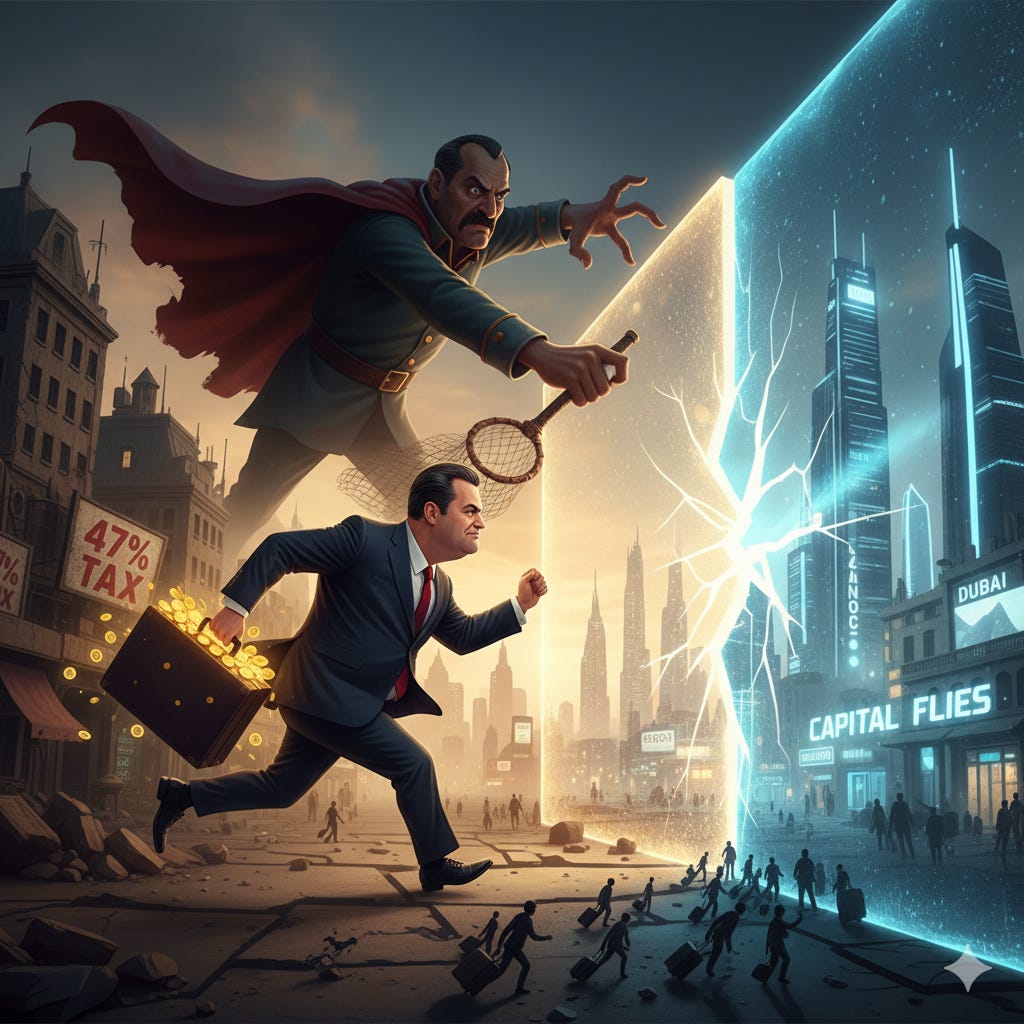
A few months ago Spain floated the idea of taxing crypto gains at 47 percent. The number hit me like a brick, not because it was surprising, but because it confirmed a pattern I’ve been watching for years.
Governments pushing harder. Citizens adapting faster. Money becoming more fluid than regulation.
It reminded me of what happened in Japan and how MetaPlanet became a tax workaround almost by accident. Crypto was heavily taxed. MetaPlanet wasn’t. So anyone who wanted exposure to Bitcoin without getting crushed simply bought the company instead.
A crack in the wall. Capital does what it must to survive.
And here we are again. Different country, same movie.
What shook me wasn’t the tax itself. It was the blindness behind it. The idea that a government in 2025 can squeeze citizens as if borders still meant anything. As if wealth can’t move at the speed of an email. As if people won’t simply pick up their assets and fly.
That same week I read a piece about European family offices shifting their centers of gravity. Not just billionaires leaving London, Paris or Munich. The actual operating systems of private wealth evolving. People moving to Monaco or Dubai. Teams staying in London. Assets in Luxembourg. Deal flow in Zurich. A global grid driven entirely by incentives.
The article mentioned how the UK alone is set to lose more than 16,000 wealthy residents this year, and how the Middle East is pulling capital at a rate we’ve never seen. Dubai jumping from 50 family offices in 2020 to more than 1,000 today. Singapore past 2,400.
It’s not collapse. It’s mobility. It’s strategy.
And if the wealthy, who have the most to lose by moving, are relocating at scale, what should the rest of us be doing? Staying put and paying? Pretending fiscal borders still work when money and talent no longer have borders?
This is where the reflection became personal. I kept coming back to a single thought:
there must be a hack.
Not a loophole.
A structural way to live inside this new asymmetric world without being stripped alive by systems designed for the 1960s.
Every time I think about it, I land in the same place.
I want to live my entire professional life using buy borrow die for (digital) assets.
That’s the mission.
My private rebellion against bad policy.
Protect core assets, borrow when needed, die with everything intact.
Simple. Logical. Antifragile.
Because the truth is uncomfortable: the only fair tax system left is the one you build for yourself. The state will not build it for you.
Borrowing isn’t just a tax strategy. It’s a mechanism that forces banks to compete. When you borrow against solid collateral (Bitcoin, gold, stocks) you’re not just avoiding the taxes. You’re redirecting what used to be taxes into interest. And that interest pushes banks to offer better products, more liquidity and better terms. Competition improves the system. Government extraction destroys it.
And this is where digital assets change everything.
Real estate used to be the main engine for buy-borrow-die. It worked for decades. But zoom out and you see it worked mostly for banks and governments.
In Spain, just buying a house means paying 6 to 10 percent in taxes upfront. Imagine buying stocks with a 10 percent spread. Imagine buying Bitcoin with that friction. You wouldn’t. Yet people accept it for houses because they think they have no alternative.
Then come yearly taxes, inheritance taxes, and the absurdity of paying capital gains on nominal appreciation instead of inflation-adjusted real returns. If you buy a house and inflation rises, you’re taxed on the inflation.
It’s disguised theft.
Digital assets don’t carry that burden. Not today. Not yet. And that window is the opportunity. A once-in-a-generation gap between innovation and regulation. A crack wide enough to build freedom through it.
My mission is simple: teach people to build fiscally efficient systems so they can get rich from their assets without feeding states that don’t respect capital formation.
Systems built on flow, not net worth. Systems where you never sell core assets, only borrow against them. Systems where dividend machines live in the flow box, BTC and hard assets in the core box, and liquidity plus optionality in the third box ready to attack when governments break something again.
Because they will. They always do.
What shocks me is how obvious this is, yet how few say it out loud. Governments treat money as if it belongs first to them and only then to you. That mentality made sense in the Middle Ages. Lords taxing land. Knights enforcing obedience. Royal decrees extracting value from farmers who couldn’t leave even if they wanted to.
But the irony was always the same. Those who extracted the most were the first to fall once mobility arrived.
Today we are living the same transition. The state thinks it owns your productivity. But your capital can fly. Your identity can be global. Your assets can live on a blockchain. Your company can be incorporated where incentives align with your freedom, not where you were born.
So I keep returning to the same idea.
We don’t need to revolt. We need to unplug. Quietly. Methodically. Through design. Through structure. Through collateral. Through flow.
The goal isn’t to destroy the system. It’s to opt out of the bad parts and let competition handle the rest. To live in a world where the only two “taxes” you pay are voluntary: inflation hedging and interest. Everything else becomes optional if your structure is built correctly.
That’s the asymmetric path. A personal sovereignty path. A path where Bitcoin is your hard base and borrowing your shield. A path that lets anyone, not just billionaires fleeing London, keep what they earn and build a life where freedom compounds.
And the window is open right now.


