Picasso or Bitcoin?
How art's status is changing among the super-rich
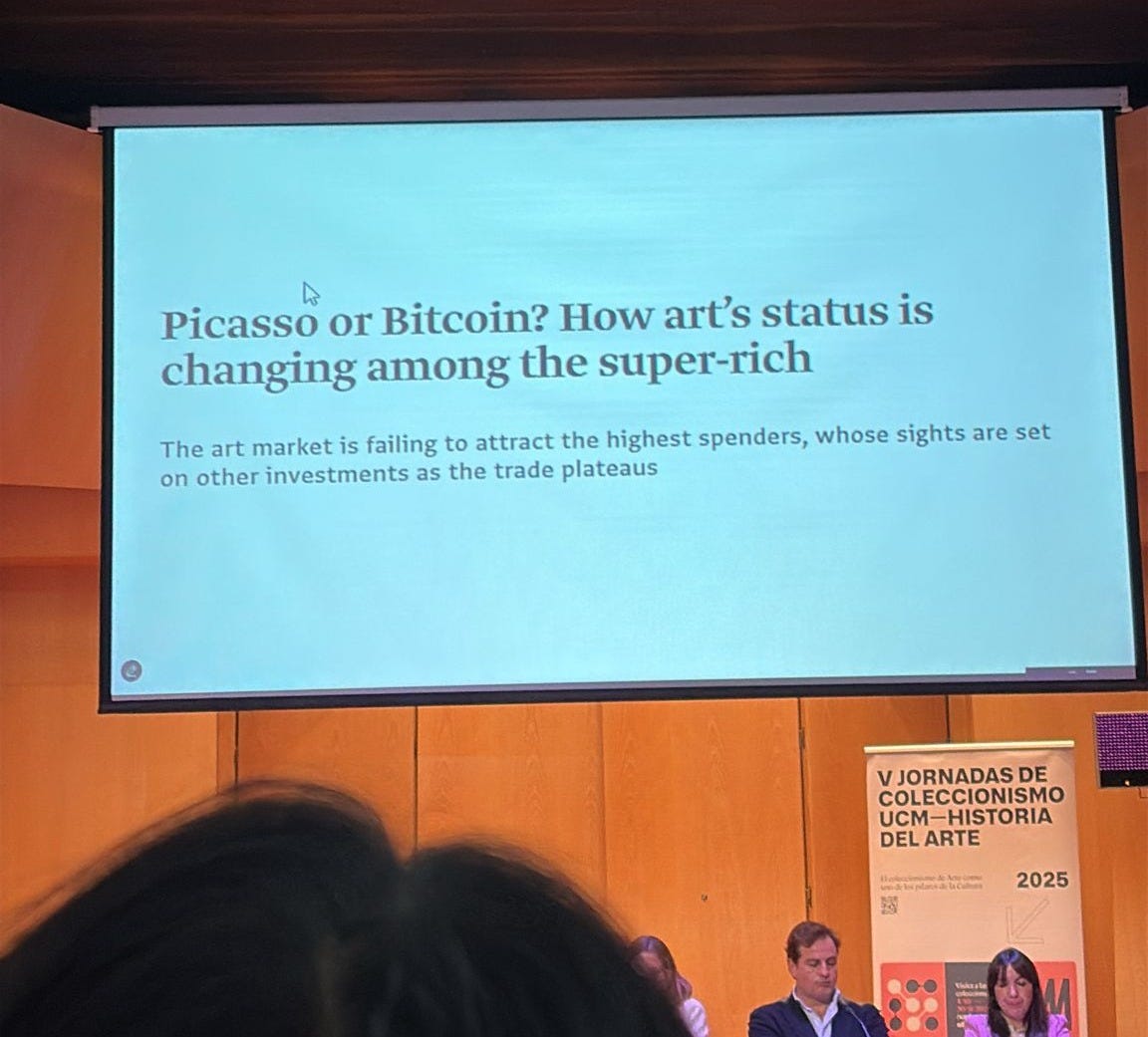
The other day I got a WhatsApp from my fiancée. She works in the art world (auctions, collectors, that whole “beautiful object” ecosystem) and she sent me a photo from a conference she was attending. The slide read:
Picasso or Bitcoin? How art’s status is changing among the super-rich.
I laughed. Told her, “That’s interesting. Grab a pen. I’m going to quiz you later.”
What that headline reveals, without meaning to, is the exact moment a legacy narrative starts to die. And a new one takes over.
Art has always been about status. Picasso isn’t paint on canvas, it’s a signal. A flex. It’s what billionaires hang on the wall to say “I made it.” But Bitcoin? Bitcoin doesn’t ask for permission. It doesn’t need a gallery. It doesn’t care about your taste.
And here’s what’s really melting the brains of the old elite: Bitcoin doesn’t just store wealth. It absorbs it. Actively. Systematically. Day after day. While art depends on buyer sentiment and media hype, Bitcoin is pulling capital like a black hole. Quietly. Irreversibly.
Right now there are a handful of players: call them fanatics, visionaries, lunatics, whatever you want, who don’t just buy Bitcoin. They accumulate it with religious intensity. Saylor. Marathon. MicroStrategy. Metaplanet. Hardcore OGs. They don’t care about dips. They want the dips.
Because dips mean weak hands are selling. And every time that happens, what’s really going on is a transfer of supply from tourists to vaults. From people who will sell at the first sign of fear… to entities who will never sell.
Think about what that does to the float. Every time someone panic-sells at $85k, they’re unknowingly handing their asset to someone who isn’t selling below $350k. Or ever. And this isn’t just some clever hodler story. It’s mechanical.
As supply tightens, and real float shrinks, the price doesn’t just recover, it grinds higher. Because even as retail bleeds out, the strongest buyers on the planet are absorbing inventory. Not to flip. To freeze.
And here’s the kicker: these same players don’t just buy the dips. They buy the pumps too.
So while retail gets distracted trying to time tops and bottoms, the whales just keep stacking. Relentlessly. DCA into perpetuity. They’re not playing the same game. They’re playing monopoly with real land.
And that means something brutal happens to the supply dynamics. Because now not only is the float shrinking, but every time the price goes up, more capital comes in. More believers. More allocators. More miners. The game reinforces itself.
Now compare that to Picasso.
Every time a Picasso sells at a record high, the incentive for another collector to sell increases. Supply follows price. It’s reflexive in the wrong direction. Which means that as value rises, so does available inventory. It caps itself.
Bitcoin is reflexive in the right direction. As price goes up, supply gets tighter. Liquidity dries up. More coins get locked. Miners get more revenue, so more miners enter. Security increases. Confidence rises. More institutions pile in.
You get a closed loop of capital, compute, and conviction.
That’s why the system can only get stronger. You either see it or you don’t.
And then comes the ETF crowd. People buying IBIT or GBTC thinking they’re playing it safe. Or equity exposure like $MSTR or MetaPlanet. But here’s the twist that most don’t grasp:
When someone sells MicroStrategy stock, they’re not selling Bitcoin. They’re selling a claim. A paper proxy. A tradable exposure. The actual BTC backing the position? It stays exactly where it is. Cold. Locked. Untouched.
So what really happens?
They’ve just made it cheaper for someone else to acquire that same BTC exposure.
That’s it.
And this is where most people completely lose the plot.
Because while the share price might drop, the Bitcoin per share goes up. Especially with companies like MicroStrategy or MetaPlanet who are constantly stacking. You’re not just buying exposure. You’re buying a rising claim on an increasingly scarce base.
That’s the mNAV. The ratio between the market cap and the actual BTC backing it. Sometimes you’re paying a premium. Other times, a deep discount.
When someone rage-sells $MSTR because Bitcoin corrected, what they’re doing is handing you more BTC per dollar than they had yesterday. That’s the asymmetry most never see.
And this flywheel won’t stop.
Because the more BTC these players accumulate, the tighter the float becomes. The tighter the float, the harder it is to move the price down. And the higher the price, the more miners enter the network because it becomes more profitable. Which makes the network more secure. Which increases institutional confidence. Which brings in more capital.
You see what’s happening?
Bitcoin’s structure rewards accumulators and punishes flippers. It penalizes impatience. It shifts wealth from those who treat it like a trade… to those who treat it like a treasury strategy.
Even mining adjusts to this reflexivity. If profitability drops, hashpower leaves, difficulty adjusts, and those who stay get more rewards. If price rises, more miners flood in. You can’t stop it. You can only front-run it or get steamrolled by it.
So yeah, Picasso or Bitcoin?
Picasso is beautiful. Legendary. Scarce in a very human sense.
But Bitcoin is mathematically finite, increasingly owned by entities that don’t sell, and secured by a global network of incentivized compute.
One stores your ego.
The other stores your freedom.


