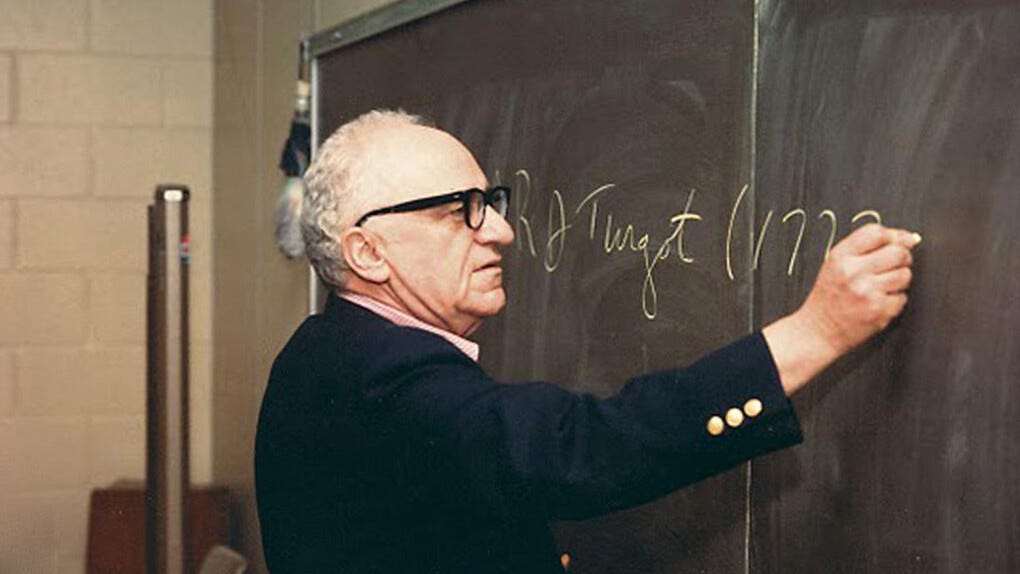
I’ve spent the past two weeks rereading Murray Rothbard. Small books, the kind that fit in a pocket and take two evenings to finish. And in one of them, written more than sixty years ago, I found the exact mechanism of the next reset. Not a date. A mechanism. Which is far more useful.
Let me give you context before I show it to you.
At this point I think there’s little room for honest debate: the Austrian school is the one that best explains how money actually works. Not because it’s elegant, but because it’s the only one that starts from how people actually behave rather than how a model says they should. Within the school you have Mises, Hayek and others. But Rothbard has something the rest don’t: he writes so you understand him. No equations. No fog.
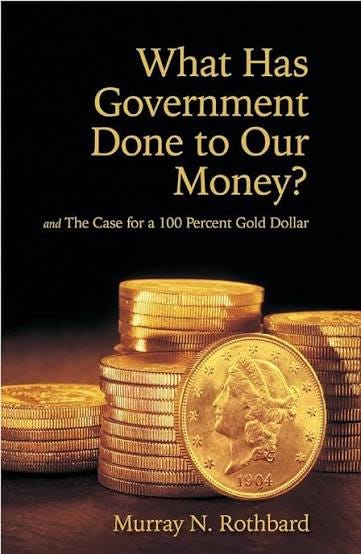
And here something Taleb repeats constantly applies: the Lindy effect. The longer a book has survived, the longer it’s likely to keep surviving. Rothbard wrote What Has Government Done to Our Money? in 1963. Sixty-three years later, every page reads like it was written to describe today’s system. That’s not coincidence. That’s signal.
The passage that stopped me cold is about fractional reserve banking. Rothbard explains that a bank’s natural brake is the size of its clientele: the smaller the bank, the more reserves it must hold, because any client can demand their money and take it to another bank. In his words, “the tinier their size, the ‘harder’ (and better) the monetary supply will be.”
To avoid the threat of bankruptcy from this quarter, then, the narrower the scope of a bank’s clientele, the greater the fraction of gold it must keep in reserve, and the less it can expand. If there is one bank in each country, there will be far more scope for expansion than if there is one bank for every two persons in the community. Other things being equal, then, the more banks there are, and the tinier their size, the “harder”-and better-the monetary supply will be. Similarly, a bank’s clientele will also be limited by those who don’t use a bank at all
Read that slowly. Because everything is in there
The argument is brutally simple. A system with thousands of small banks limits itself: if one bank expands credit faster than its neighbors, its notes and deposits end up in the hands of other banks’ clients, who demand payment. The reckless bank fails fast and fails small. The damage is contained.
Now invert the logic. The fewer banks there are, the more room to expand. If only one bank exists in a country, no one can demand payment from the outside, because there is no outside. The only limit left is confidence. And confidence is an asset that works perfectly until the exact second it stops working.
Let’s use simple numbers. With a hundred competing banks, the one that lends too much loses reserves to the prudent ones and the market disciplines it within months. With five banks, all of them can expand at once, coordinated de facto, and the discipline vanishes: there’s no prudent competitor left to run to. With one bank, expansion has no technical brake at all. It only has an ending.
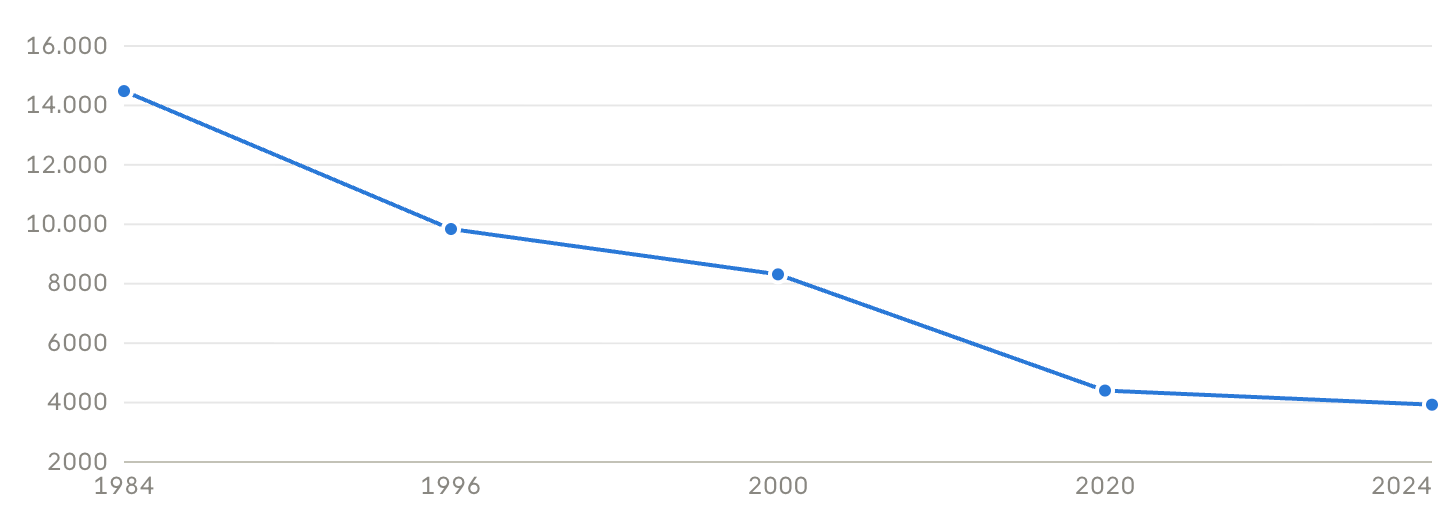
Now look at the data. In 1984 there were more than 14,000 commercial banks in the United States. Fewer than 4,000 remain today, and the number falls every quarter, almost always through mergers. The four largest concentrate more than twelve trillion dollars. Europe is worse: there are countries where three institutions control over 90% of banking assets. And every crisis accelerates the process, because every bank that falls gets absorbed by a giant. 2008 did it. 2023, with Silicon Valley Bank and Credit Suisse, did it again.
We are running Rothbard’s experiment in real time. Fewer banks, bigger, more leveraged against each other, holding the same collateral and running the same risk models. The entire system is converging toward a single balance sheet.
Here comes the nuance almost nobody adds, the one that separates understanding Rothbard from reciting him.
Rothbard was describing a world with redeemable gold. In that world, the ending was a classic bank run: people racing to the teller window and the window standing empty. But that world no longer exists. Today the lender of last resort prints the very money it owes you. It cannot fail in nominal terms. The window will never run out of euros or dollars.
Which means the reset won’t be a bankruptcy. It will be a dilution.
When the consolidated banking system hits its limit, you won’t see lines outside branches.
You’ll see:
bailouts,
forced mergers,
soft capital controls dressed up as regulation,
Perhaps a digital currency that turns your deposit into a direct liability of the central bank. The single bank Rothbard imagined as an extreme hypothesis already has a name and a headquarters. The run won’t be toward the teller window: it will be out of the system. Toward assets nobody can print or freeze.
And that tells you exactly how to position yourself.
You don’t need to predict the date. You need to be structurally outside the mechanism before the mechanism reaches its limit. Your core box (Bitcoin in self-custody, physical gold) is precisely that: the part of your wealth that is nobody’s liability. Your operating liquidity, the bare minimum, spread out and held with the awareness that a deposit is a loan you make to the bank, not money in storage.
And your optionality ready, because every acceleration of this process creates dislocations, and dislocations are where wealth gets built if you arrive with liquidity and without fear.
Rothbard didn’t give us the date of the next reset. He gave us something better: the blueprint of the building and the direction it’s leaning. The rest is a matter of not being inside when it finishes falling.
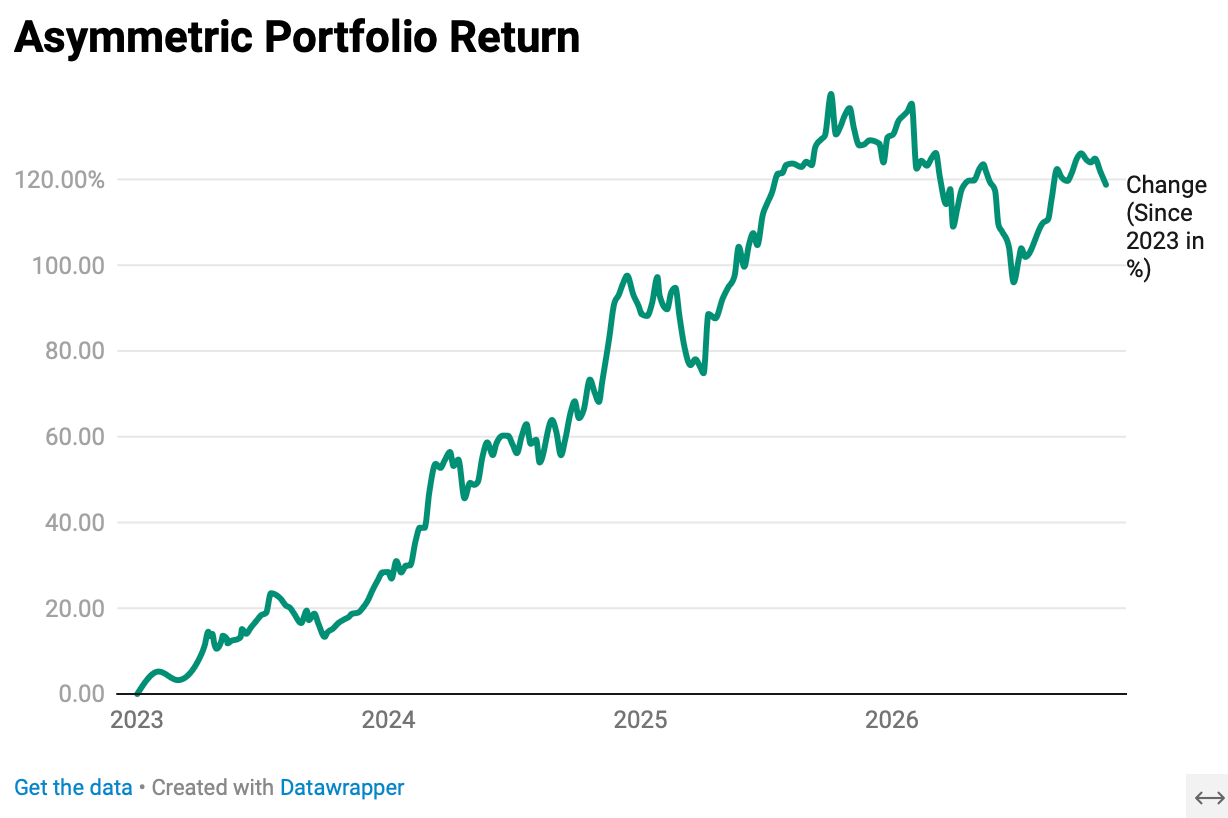
Now our portfolio…
I’m working on a feature that will let you see your entire portfolio in real time, along with many other AI-powered features, from portfolio generation to measuring how asymmetric your portfolio is…
Of everything I’ve seen, this is one of the newsletters that gives you the most for the least.
If you don’t want to take my word for it, take a look at what Naval posted this week…

📈 Asymmetric Finance Portfolio
Updated on 7th November