
I promise not to talk about Saylor again for a long time
On June 21st I wrote that Saylor should buy back his own preferreds.
MicroStrategy was in terrible shape. Bitcoin at lows. STRC had dropped to the low 70s, 30% below par. The peg, broken. And I published this article saying that if Saylor started buying back that paper, the trade would be brutally accretive for investors.
This Monday, Strategy published a PDF I’ve read line by line all week. And there it is, in black and white: a preferred buyback program, with STRC as the priority.
Not that he listened to me. It was simply the obvious move. When the market sells you your own perpetual debt at 70 cents, there is no easier capital decision on earth.
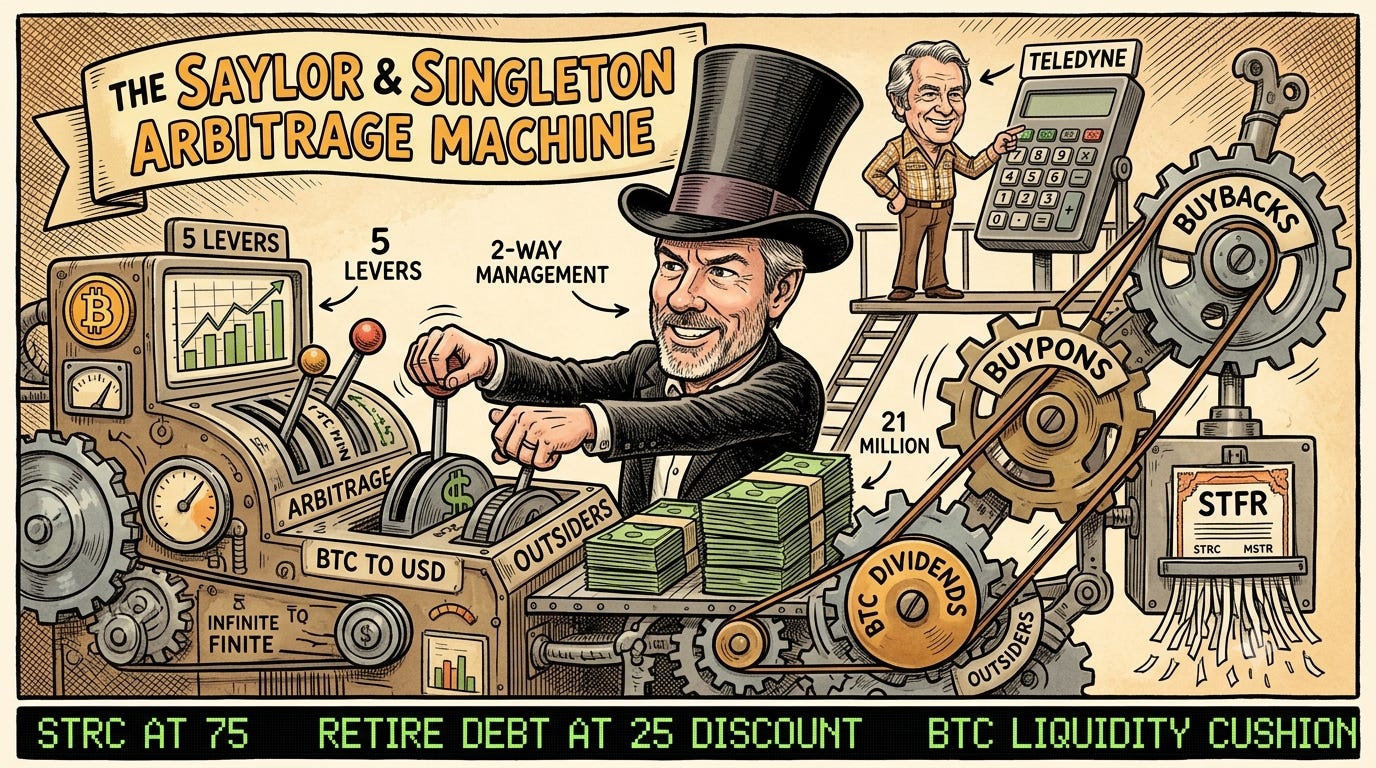
Let’s go through the levers. The framework has five, and each one fits in a sentence.
First: a USD reserve of $2.55 billion that can only be used to pay dividends and interest, with a mandatory minimum of twelve months of coverage. The message to the market: coupons get paid no matter what Bitcoin does.
Second: the STRC dividend rises to 12% and gets reviewed every month. It’s a thermostat. The stated goal is for STRC to trade between 99 and 100. If it cools off, turn up the heat.
Third and fourth: one billion to buy back preferreds and another billion to buy back MSTR whenever it trades below intrinsic value.
Fifth: authorization to sell up to $1.25 billion in Bitcoin to fund all of the above.
Five levers, one idea: moving from one-way issuance to two-way capital management.
And here is the arbitrage almost nobody sees.
STRC is an infinite promise. Fiat paper: $100 of face value and a coupon forever, issuable in whatever quantity the market will absorb. Bitcoin is the opposite: 21 million and not one more.
For five years the trade ran in one direction only: issue infinite to buy finite. What Saylor announced on Monday is that the trade now works both ways.
Run the simple math. If your paper trades at 75, buying it back generates 25 instant dollars per unit and permanently retires a 12% coupon on 100. That’s extinguishing a perpetual obligation while paying yourself an effective 16% yield. No market risk. No counterparty. There isn’t a bond on the planet that offers his treasury that.
And if he sells some Bitcoin to do it, he isn’t betraying the thesis. He’s selling finite expensive relative to his own paper to retire infinite cheap. When the paper returns to par, he issues again and rebuilds the Bitcoin. Buy low, sell high, using his own instruments as the counterparty.
This has been done before. And we know how it ends.
Henry Singleton, Teledyne (I read about this story in the Outsiders book). In the 1960s he issued wildly expensive stock, at 40 and 50 times earnings, to buy companies. When the market collapsed in the 70s and his stock fell to a single-digit P/E, he reversed the flow: between 1972 and 1984 he bought back 90% of his own shares. The result: over 20% compounded annually for two decades, and Buffett calling him the best capital allocator in American business history. Singleton had no magic product. He had a calculator and zero emotional attachment to the direction of the trade.
Saylor just put himself in that position. Issuer when his paper is expensive. Buyer when it’s cheap. With a cushion of 25 months of dividends that means he never sells out of obligation, only out of opportunity.
If you hold STRC, the company is now the buyer of last resort of its own paper. If you hold MSTR, every buyback below par is Bitcoin yield without issuing a single share.
And for us, the lesson never changes: the best returns don’t come from predicting the market, but from having the liquidity and the cold blood to arbitrage other people’s pricing errors. Even when the mispriced paper is your own.
Now our portfolio…