

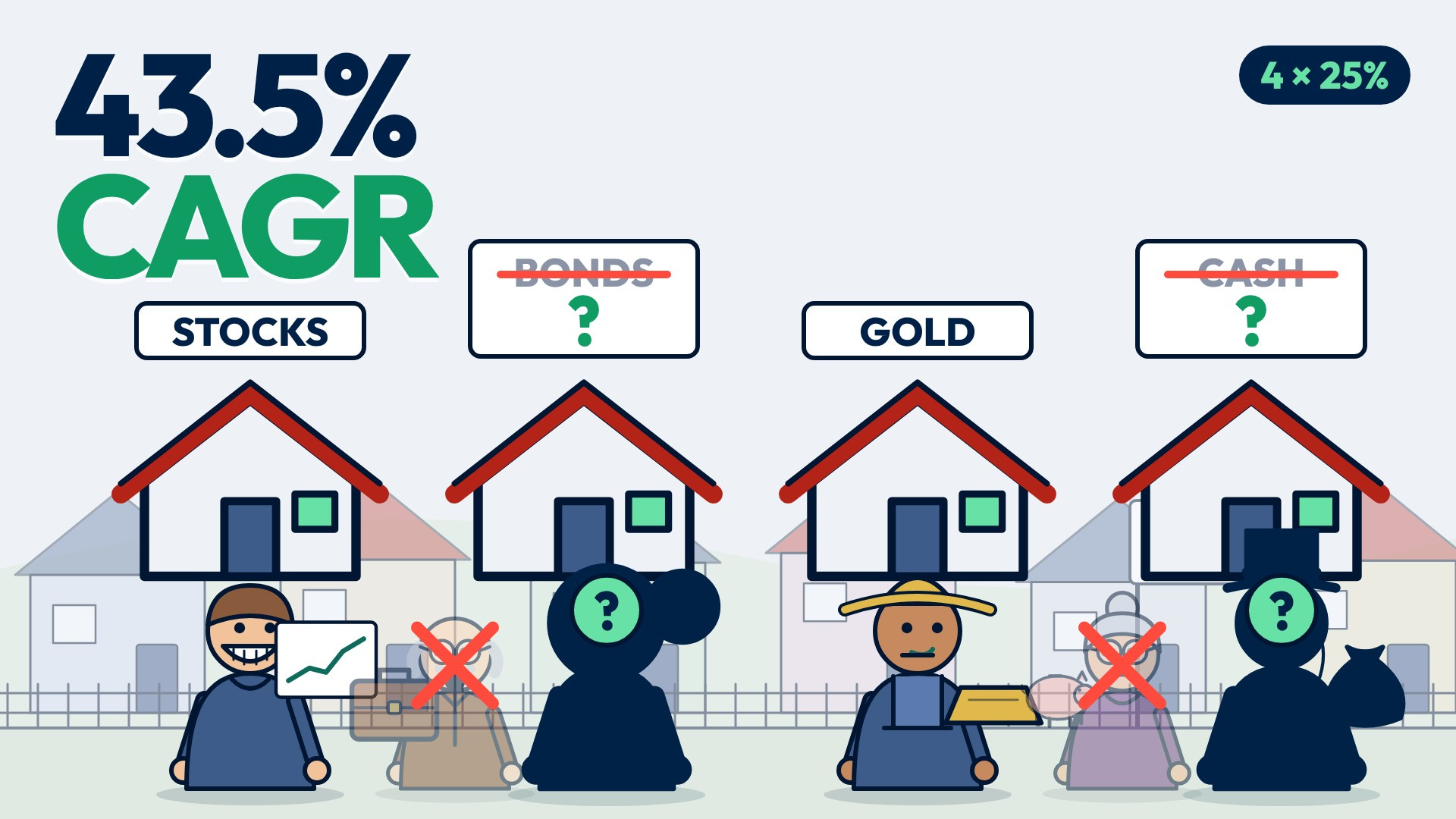
Many of you know I started this newsletter over five years ago with one goal: to learn and share what I learn. Since then, I’ve tried to bring value with every publication, spending hours researching and thinking through every idea.
Today, I’d like to use this free article for my 4,000+ subscribers to introduce a new initiative: my YouTube channel.
I won’t keep you long. All I’m asking for is a subscription and a like to help it grow. Video 0: Meet the Characters.
The other day I was listening to a guy explaining portfolios by risk profile. For the conservative investor, the usual. For the aggressive one, this: 20% Nasdaq, 30% equities, 40% China and 10% bonds.
He delivered it with a confidence that was a pleasure to hear.
I got stuck on the second line. Nasdaq and equities aren’t two different things, it’s the same thing counted twice so the table has four rows instead of three.
Then the 40% in China, sold as decorrelation. When the one day arrives where decorrelation actually matters, the day everything falls at once, China falls with everything else and throws in a political risk you didn’t have before.
He finished with 10% in bonds and the textbook line: aggressive but uncorrelated.
That wasn’t an asset allocation. It was a bet on global equities wearing four different names.
And that’s when I thought of Harry Browne.
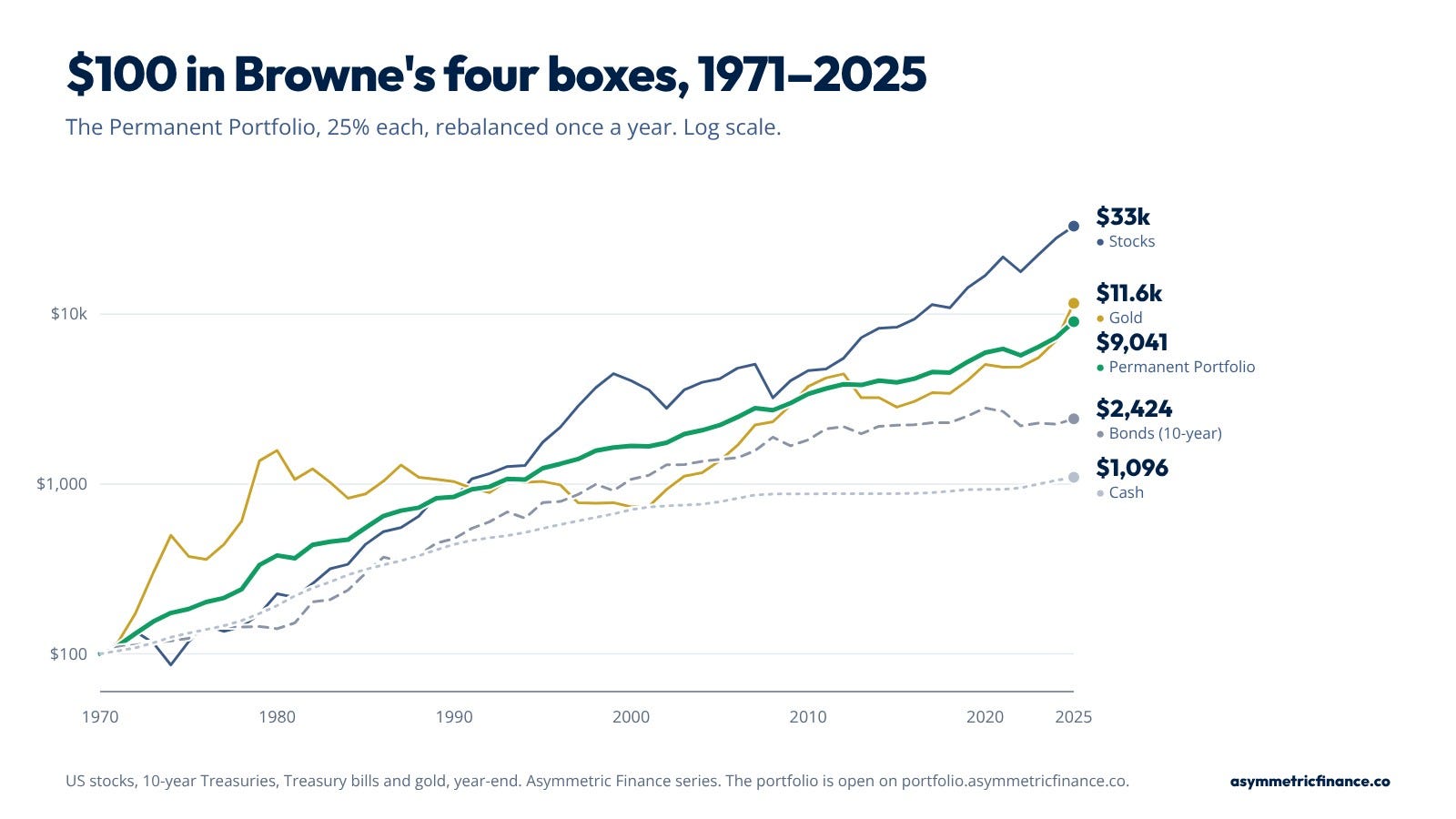
The Permanent Portfolio has been taking abuse for decades. 25% equities, 25% long bonds, 25% gold and 25% cash, which sounds like cowardice and leaves people staring at half their net worth sitting in things that don’t yield anything.
What almost nobody sees is why those four and not any other four.
Browne didn’t pick assets. He picked monetary regimes.
Stocks for prosperity. Long bonds for deflation, gold for inflation and cash for the liquidity blackout, that moment when money dries up and whoever holds it buys cheap from whoever doesn’t.
Four boxes, four tickets. One of them is always paying out.
Dalio later built the institutional version with risk parity, but the bone underneath is identical. And there’s something almost everyone gets wrong about this: the exact percentages matter far less than people think.
When the assets are genuinely different, the gap between 25/25/25/25 and 30/20/30/20 becomes statistical noise. What decides the outcome is that they’re four genuinely different things and that you don’t touch them.
The problem with the Permanent Portfolio in 2026 isn’t its logic. It’s that two of its four boxes have lost their tenant.
Long bonds have delivered a negative annualized return for ten years, and not through bad luck. Browne’s deflation box assumes there’s a solvent state you lend to for thirty years that gives you back purchasing power.
That state no longer exists.
Once debt crosses the threshold where inflating is the only politically viable exit, the long bond stops being insurance and becomes the asset the policy is executed against. And cash yields below real inflation by design, because that’s what it’s there for.
So the substitution makes itself. Long bonds out, Bitcoin in. Cash out, Strategy’s Stretch in, paying 12% a year in cash every fifteen days.
Four assets. Twenty-five percent each.
And while I’m at it, I’ll put my name on it (Carlos Pascual portfolio, I would have to look for a more catchy name). Maybe somebody writes me a book.
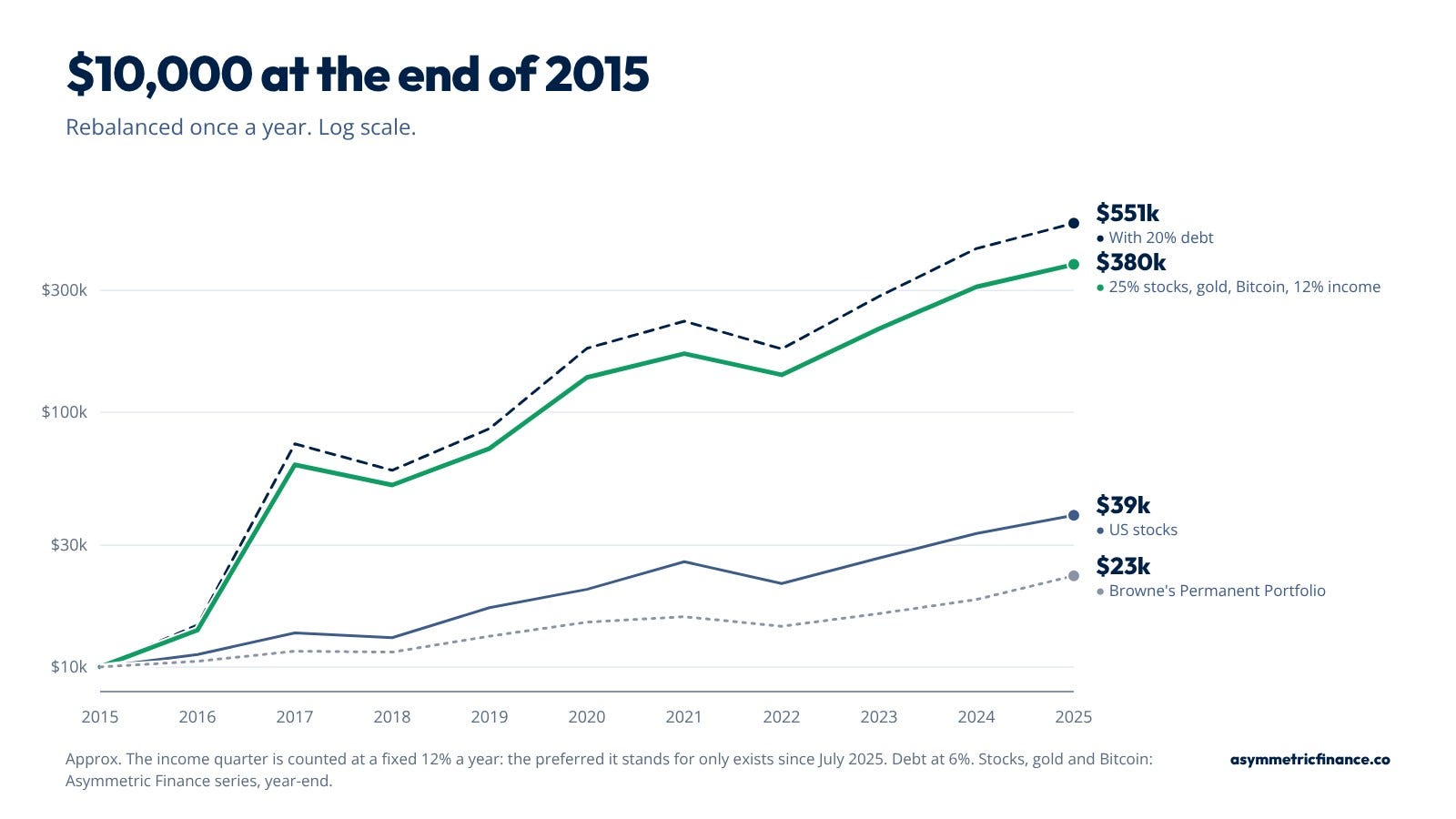
Rough backtest from 2016 to 2025 with annual rebalancing. Browne’s portfolio returns 7.8% annualized and this one returns 43.5%.
You multiply by thirty-seven over ten years, and the worst year of the period, 2022, comes in at -17.6%.
That’s where the first objection lands, and it’s the one I’d have made myself three years ago. Putting 25% into Bitcoin means putting in an asset that has eaten 85% drawdowns from its highs, and that breaks any portfolio designed to avoid catastrophic years.
It was true. It has stopped being true, and the numbers show it without requiring any faith.
Bitcoin’s maximum drawdowns from all-time highs have gone in a straight line downward cycle after cycle. 94% in 2011, 87% in 2014, 84% in 2018 and 77% in 2022.
In this cycle, from $126,210 in October 2025 to the mid-2026 lows, the drawdown has been roughly 50%. Half of what used to be normal.
Implied volatility has compressed to half its historical average. And realized price, which is the true average cost basis of every holder, sits at 44% of the cycle top versus the usual 25%, meaning there’s far less speculative excess waiting to be flushed out above the floor.
That’s exactly what an asset does when it institutionalizes. The ceiling comes down and the floor comes up.
You’re going to make less than in 2017, which we already knew. In exchange you get an asset whose left tail has been cut in half.
For a permanent portfolio that trade is the best deal of the decade. This structure doesn’t need Bitcoin to do 300% in a year, it needs Bitcoin not to go to -85%.
The second objection is the preferred, and I know it by heart because I’ve written it myself: that isn’t cash.
Correct. It isn’t trying to be.
Browne’s cash wasn’t there as a sentimental cushion, it was there to generate stable liquidity and dry powder. An instrument paying 12% a year in cash does that job considerably better than a 2% deposit.
And on the stability of the principal, the test has already been run for real.
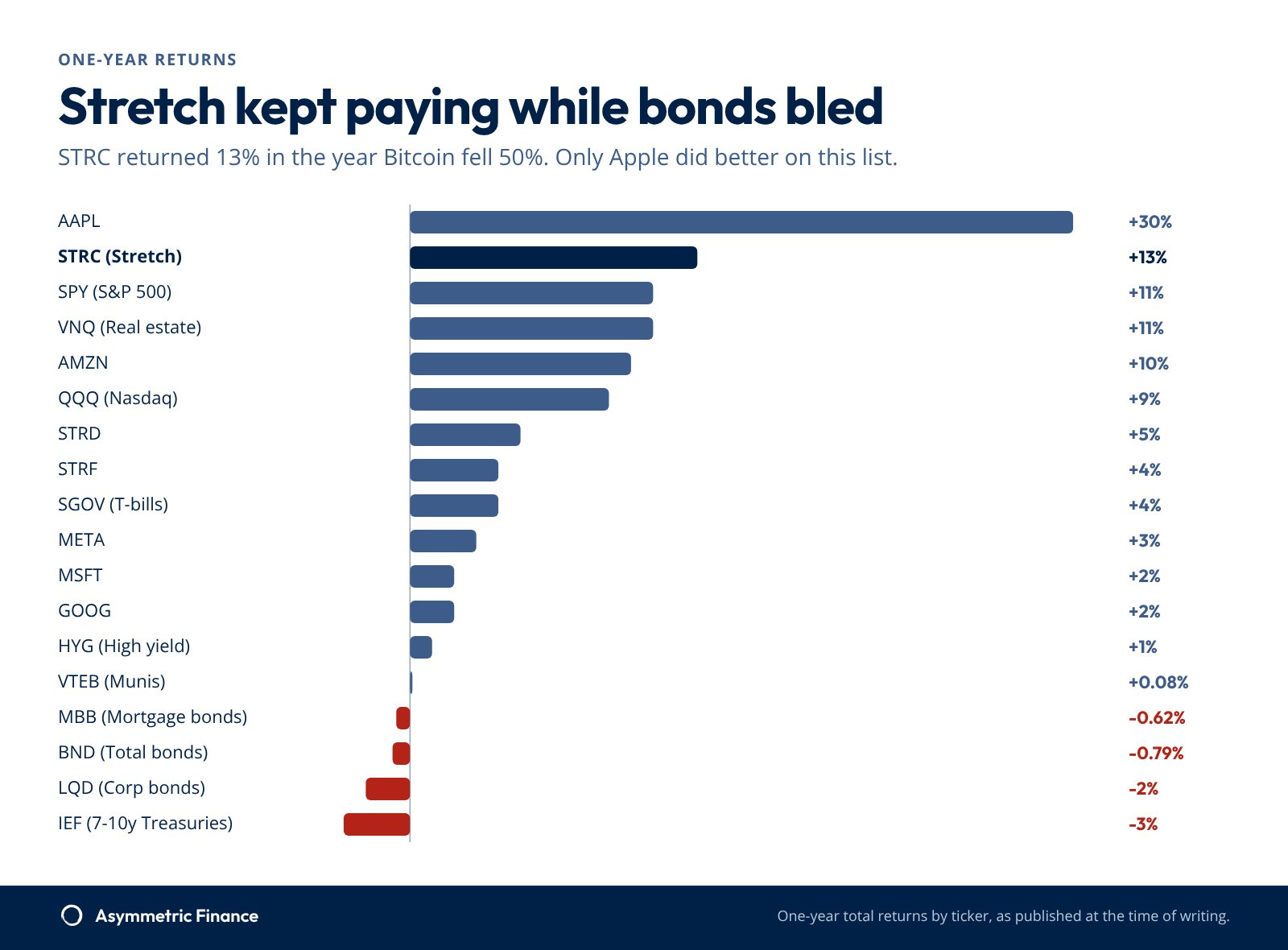
Stretch is variable rate and the company adjusts the coupon every fifteen days with the explicit goal of keeping it trading between $99 and $100. When it drifts below, they buy it back, as they did with $28.9 million of notional at a 13% discount.
While Bitcoin was losing 50% from October 2025, Stretch stayed anchored around par and the coupon kept landing every two weeks.
The company’s dollar reserve didn’t shrink during the drawdown either. It went from $2.25 billion in February to $5.10 billion at the end of August, plus another $1.61 billion of free cash, against roughly <$1.7 billion a year in dividends and interest.
They’re reinforcing the coverage in the middle of the storm, not spending it.
All of this stops being theoretical when you put this cycle’s real numbers into the portfolio. Bitcoin down 50%, global equities flat thanks to the rotation into AI, gold up close to 20% and Stretch essentially nailed to par.
Result for the full portfolio: around -11%. In Bitcoin’s worst year of the institutional era.
Under a much harsher scenario, Bitcoin at -60% and equities at -25%, you land at -20%. That’s the real range, and it’s why this structure carries 25% in the most volatile asset on earth without breaking a sweat.
And if that’s where the floor is, then the right question isn’t whether the portfolio holds up.
It’s why you’re letting it work unlevered.
Twenty percent of debt on a portfolio with this maximum drawdown is one of the most conservative things you can do with a margin account. You take the period return from 43.5% to 48.9%, you multiply by fifty-three instead of thirty-seven, and the worst year moves from -17.6% to -22.3%.
But the arithmetic isn’t the beautiful part. How the debt gets paid is.
25% of the portfolio yielding 12% throws off 3% a year in cash on total net worth. A 20% loan at 6% costs 1.2%.
The portfolio covers its own debt service two and a half times over, in cash, every fifteen days, without selling a single unit of anything.
That’s what turns this into something else.
In a normal buy-borrow-die, the risk is the margin call, because the debt doesn’t pay itself and at some point you have to liquidate core to service it. Here the cash engine sits inside the structure itself.
The preferred pays the interest. Gold and equities absorb the shock, and the Bitcoin never gets touched except at the annual rebalance, which mechanically forces you to sell high and buy low.
So yes, I’m putting my name on it.
25% global equities, 25% gold, 25% Bitcoin in self-custody and 25% Stretch, with annual rebalancing and 20% of debt against the whole thing. Four assets, four regimes, a cash engine that finances its own leverage.
The only thing that breaks this is Strategy suspending the dividend permanently. That’s the point of failure and it’s worth writing down somewhere visible.
As long as that reserve keeps growing during drawdowns instead of shrinking, I sleep fine. And if one day it stops growing, that box gets swapped and the structure still stands, because Browne designed boxes, not assets.
The AF Portfolio, open 24/7
Paid subscribers can check it whenever they want:
Every position, its weight and live performance, tail hedges included
Your own mix next to mine, and the date it could set you free
The famous portfolios (Dalio, Buffett, Taleb, Bogle) side by side, with backtests
Just upgraded? Give it up to 24 hours: that’s when your subscription syncs. Then sign in with the email you subscribed with and you’re in.
Not a paid subscriber yet? Upgrade and it’s all yours.