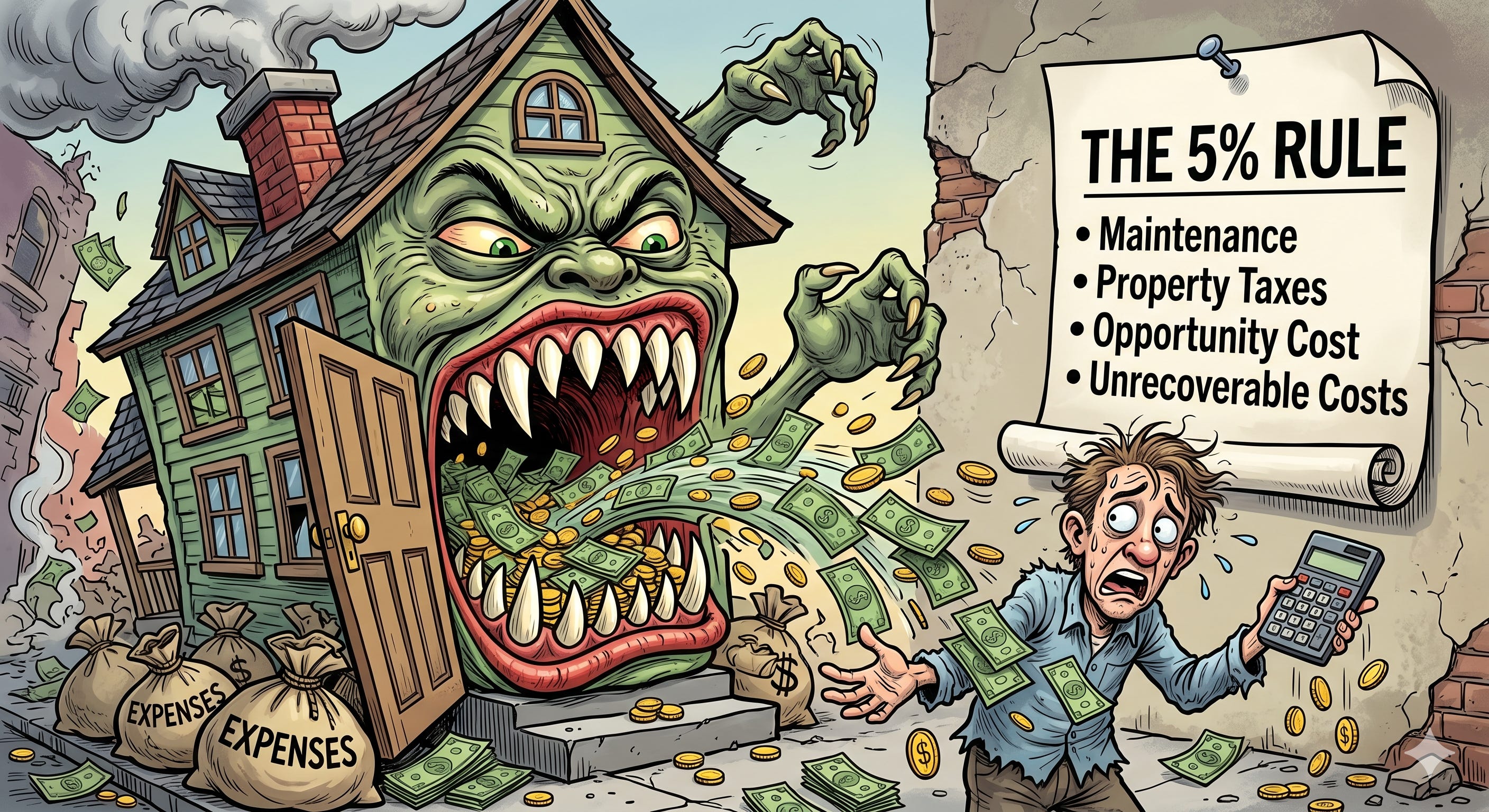
The 5% Rule
your house is an expense
A few days ago I argued about this with a friend (I wrote about it). He’s convinced buying is the only sane move. I tried to explain why the numbers, when you actually look at them, don’t always agree.
He didn’t buy it.
Then over lunch I told my father-in-law I was considering renting a bigger place with Elena instead of buying another property. The reply came without thinking.
“But son, renting is throwing money away. Yours, at least, is savings.”
I nodded. But that sentence is where the problem starts. It contains a mistake. An expensive one.
Rent is money that leaves and never comes back. True. What almost nobody calculates is that buying a home also has a portion of money that leaves and never comes back. And in most major-city markets, that portion is bigger than the equivalent rent.
Canadian portfolio manager Ben Felix put numbers on that invisible portion. He called it the 5% Rule.
The formula is offensively simple. Take the value of the house. Multiply by 5%. Divide by 12. That’s your monthly unrecoverable cost of ownership. If you can rent the same place for less, renting is the rational call.
A $500,000 home: $25,000 a year, $2,083 a month break-even. In Madrid, Lisbon, Berlin, Austin, most rent for considerably less. The rule, blunt as a Canadian winter, says: rent.
The 5% breaks into three parts. 1% maintenance. 1% taxes, insurance, fees. The third tranche is where everyone stumbles: 3% cost of capital, interest plus the opportunity cost of your down payment.
That last component is the one that hurts. If you put $100,000 down, those $100,000 are not in equities, not in gold, not in Bitcoin, not generating yield. They are sitting as collateral for a loan whose only purpose is to buy you a roof. The historical gap between residential real estate (~1.3% real annual return since 1900) and global equities (~5.2%) is not a footnote. It is the actual price of ownership.
The 5% Rule offends people the first time they hear it because it exposes a lie we’ve swallowed for decades.
A primary residence is not an investment.
It’s an expense. An expense that sometimes carries an investment component. But the heart of the operation is to live in it, not to compound. Confusing the two is what keeps households convinced their net worth is growing when, in fact, it’s just living somewhere more expensive.
Ricardo Salinas Pliego, Mexico’s third-richest man at $13.4B, has been saying it on every podcast he sits on, without a filter: “A house is the worst investment of all. The damn house is an expense, and that’s how you should see it. If you want security, sell the damn house, rent it, and buy yourself Bitcoin.”
He always adds the line that does the most damage: “It’s not your house. It’s the bank’s.”
There’s a structural angle every asymmetric investor should see. Between 2008 and 2010, US home prices fell more than 20% from peak. Rents barely moved, the national median dropped around 2%, with 5–8% declines in the worst-hit metros like Las Vegas and Phoenix. Owners were trapped in negative equity, paying down mortgages on assets that had cratered. Renters had options. They could renegotiate, downgrade, upgrade, or simply walk. In most jurisdictions, annual rent hikes are capped at inflation. The downside is bounded. The upside (moving when prices crack) is real.
That asymmetry is invisible on a balance sheet and enormous in a life.
Renting isn’t throwing money away. Renting is buying optionality.
The classic case for buying, forced savings, is honest. The mortgage chains you to a bank for thirty years so you don’t blow your salary. Fine. But then the asset isn’t the house. The asset is the discipline the house imposes. And that discipline can be bought directly, by routing capital to your portfolio every month before you see it.
For anyone who already understands Buy-Borrow-Die, the math hides something more uncomfortable. Every dollar locked in your primary residence is a dollar that doesn’t generate cashflow, can’t be elastically collateralized, and only monetizes by selling. A well-built portfolio works for you every month. A house, at best, shelters you.
Your portfolio works. Your house shelters.
Both are legitimate. They are not the same thing. And whoever understands Buy-Borrow-Die (and actually wants to be free) can build the life where the portfolio carries the weight and the roof is just a roof. Owned or rented, paid off or leveraged, the question stops being identity and becomes design. Freedom is available to anyone who decides the math matters more than the story.
The 5% Rule doesn’t tell you what to do. It tells you the cost of not having thought.


