I just finished a four-book saga and I sat staring at the wall for a long while.
I expected more of the same. I found something else.
The saga is Los trucos de los ricos, “The Tricks of the Rich”, by Juan Haro. The first book is over ninety tricks to multiply your wealth, protect it, and reduce your taxes legally. Structures. Companies. Entities abroad. The plumbing the rest of the world never sees, the kind people with real assets use every day. You can’t apply all of them. But there’s genuine material in there.
The second book turns to real estate. Buy, optimize, live off the rents. Pure Kiyosaki. Twentieth-century thinking, bricks and leverage.
The third climbs another floor and gets inside your head: time, habits, how someone who already has it thinks.
And I assumed the fourth would just continue. Another floor in the same building.
It wasn’t.
The fourth book talks about only two things. Bitcoin. And one word: freedom.
That’s where I stopped. Because the building did have floors. But the last book wasn’t another floor.
It was the door.
The interesting part isn’t Haro’s turn. It’s that the turn isn’t his. It’s the same arc every fortune walks, without exception. You spend the first half of your financial life learning how to make money. And the second half discovering that making it and keeping it are two completely different skills.
Almost nobody has both.
That’s why some people go broke three, four, five times and come back rich. It isn’t luck or some coach’s resilience. It’s that they master one half of the problem and not the other. They know how to generate. They don’t know how to protect. And what you don’t protect, sooner or later, gets taken: a creditor, a divorce, a cycle, a state, a timing mistake.
Keeping requires structures. Haro writes it and I’ll sign it. But a structure you don’t understand isn’t a shield. It’s a cage. It ties you down, it costs you money, and the day you actually need it, you don’t know how to operate it.
The family office was history’s answer to this. The exit the rich built when the complexity became unmanageable. A layer of expensive people whose only job is to protect what you already have. And it works. In exchange for fees that bleed the capital decade after decade, quietly, the whole way down.
That’s where that image fits, the one I saw in a family office newsletter. The billionaires’ list of worries. The UBS survey.
Tariffs, 66%. Major geopolitical conflict, 63%. Policy uncertainty, 59%. Inflation, 44%. Debt crisis. Higher taxes. Global recession.
Read it properly, because most people read it wrong. Those aren’t sixteen separate worries. It’s a single worry wearing sixteen masks.
They all say the same thing: my wealth lives inside systems governed by decisions I don’t make.
A tariff is a politician’s pen. Inflation is a central banker’s choice. A tax hike is a parliament’s vote. A debt crisis is a sovereign’s arithmetic finally catching up. Policy uncertainty is someone, in some office, who hasn’t yet decided what to do with what’s yours.
And here I’ll be honest, because the easy move would be to sell you the whole story. Bitcoin doesn’t make a recession disappear. It won’t spare you a drawdown — it’s volatile and short-term it correlates with risk. It doesn’t cure a pandemic or cool the planet. Three or four lines on that list it doesn’t touch, and those are precisely the ones that aren’t wealth-protection problems at all, but physical facts of the world.
But strip those out. Look at what’s left.
Almost everything that remains is fear of depending on someone else’s discretion. And that dependence is exactly what Bitcoin removes. No parliament votes its supply. No central bank dilutes it. No border stops it. No bank freezes what only you hold the keys to.
That’s why Haro’s arc unsettled me. Because it’s mine. And probably yours.
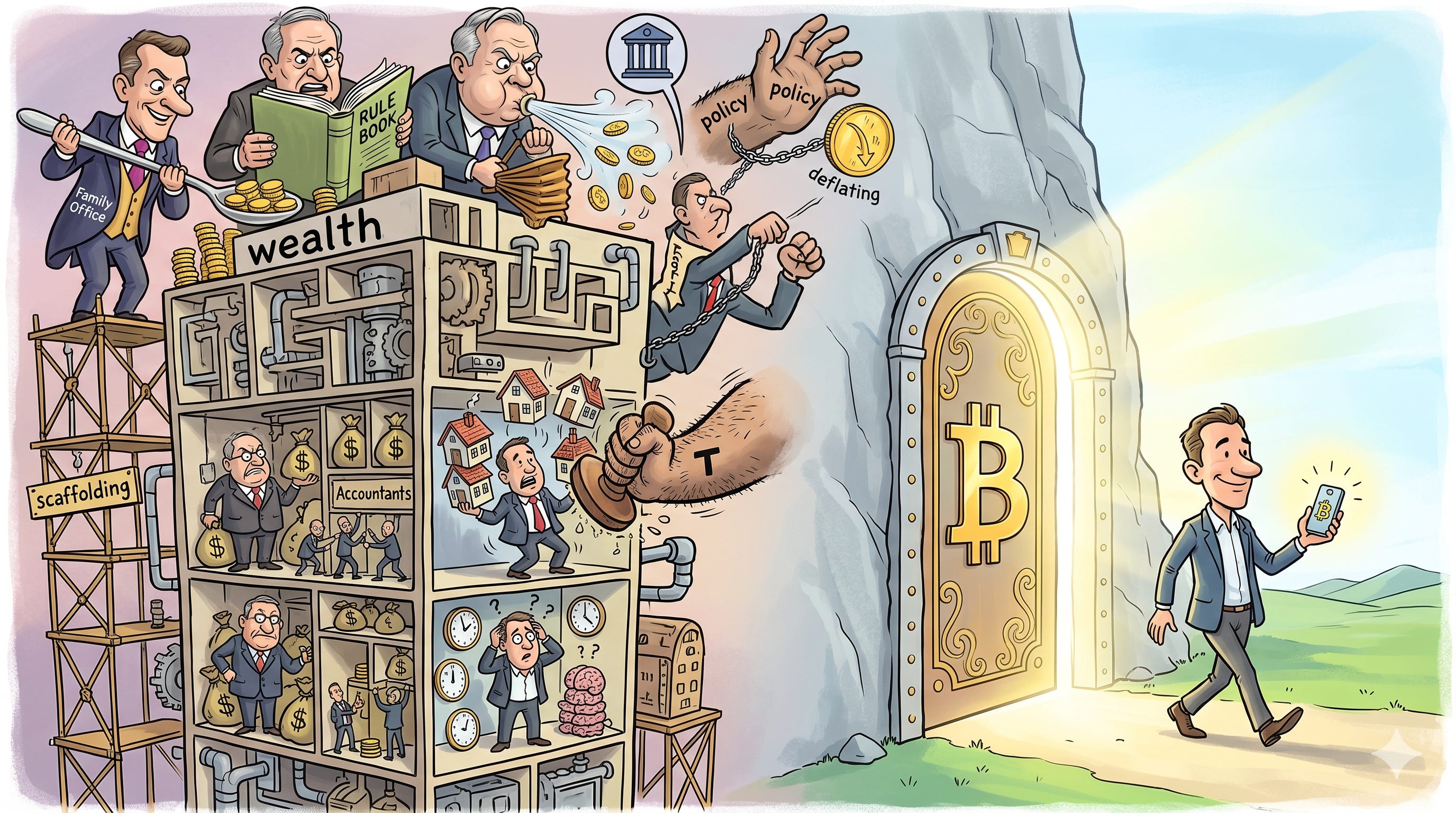
You start doing things the way they were done before. Complex. Companies, layers, optimization stacked on optimization. You believe sophistication is the goal. And one day you realize that all that machinery — the holding company, the structures, the family office — was never the objective. It was scaffolding. Scaffolding built around assets that couldn’t protect themselves.
Gold had to be stored and moved. Real estate is nailed to the ground, the tax authority sees it, taxes it, and you can’t send it anywhere. Money in the bank is someone else’s liability. All that plumbing existed because the asset, on its own, was defenseless.
Now there’s an asset that protects itself by design.
And the complexity collapses into a phrase. Your keys, your money.
Don’t misread me: this doesn’t mean liquidating everything tomorrow into a cold wallet. I’m a Spanish tax resident. I have a holding company, bricks, a world of real obligations. The path is transition, not a leap. Purity is the destination, not next Monday.
What it means is knowing which game you’re playing. The making game. Or the keeping game. They’re different, they demand opposite mindsets, and confusing them is what ruins the people who had already made it.
People kill themselves trying to guess whether the next semiconductor ETF will beat copper, zinc, or palladium. As if that were the game. It isn’t. It never was. The rich didn’t get rich by calling the sector of the year. And they certainly don’t stay rich there.
They stay rich by answering one question: how do I keep this beyond the reach of everyone who’d like a piece.
It took Haro four books to arrive at an answer that now fits on a coaster.
You decide which floor you stay on. The door has been open for years.
By the way, I asked Gemini to design this cover art, and I don't think it could have been described any better. I highly recommend you stop and study it closely for a couple of minutes.


