

What if Warren Buffett is wrong when he says he’d simply leave his family invested in the Standard & Poor’s 500 and nothing else?
It’s a comforting idea. Feels clean, classic, proven. The market always goes up. Right?
But that worldview collapses the moment you shift your lens from nominal returns to real value. From price to purchasing power. From numbers to money itself.
Because when you invest in an index like the S&P 500, you’re not just buying companies. You’re buying future cash flows denominated in a specific currency. And your real return depends not only on the business, but on the long-term integrity of that currency.
And here’s the trap: most investors never factor that in.
Let’s run a simple thought experiment. Build an index of the top 100 companies in any country: Zimbabwe, Japan, South Africa, Argentina, Germany, Venezuela, Russia. Then roll that index back over the last 50, 70, 100 years. Now measure it not in local currency, but in hard money, like gold, Bitcoin or high-end real estate.
The result? Most of these indices tend to go to zero in real terms.
Why? Because each one of them is implicitly a bet on the currency it’s tied to.
Some real-world examples:
Zimbabwe, Venezuela, Argentina: multiple collapses, endless money printing, repeated hyperinflation.
Germany: wealth wiped out after WWI and again after WWII.
Russia: currency reboots, capital controls, loss of convertibility.
Japan: deflationary traps, lost decades, real stagnation despite nominal stability.
In fact, when you zoom out long enough, you’ll find that 95% of currencies (and their corresponding local stock indices) have failed to preserve real wealth. Not temporarily. Not in a bad year. But over the full arc of monetary and geopolitical history.
That’s the part nobody teaches you in business school.
That’s also why assets like gold, which are not tied to any single currency or central bank, have historically preserved purchasing power through war, collapse, and institutional breakdown. Not because gold is magical. But because it escapes the trap of local currency erosion.
So when someone says “just buy the index,” the real question is: “which index, in which currency, over which timescale?”
And here’s where we hit the blind spot.
By defaulting to the S&P 500, we’re cheating ourselves. We’re picking the best survivor. We’re anchoring to the one that didn’t fail (yet) and pretending that’s the norm.
But that’s backwards logic. That’s survivorship bias in its purest form.
Yes, the S&P 500 has delivered extraordinary returns in USD terms. But that’s precisely because (for now) the U.S. dollar has been the dominant global currency. The “least bad” fiat.
That doesn’t make it eternal.
Empires fall. Monetary regimes change. Reserve currencies die.
And the S&P 500 will fall too, maybe not today, maybe not tomorrow. But to believe it will always remain the “safe index” is to believe in financial exceptionalism that history has proven false again and again.
It doesn’t mean we shouldn’t invest in it.
But it does mean we need to be clear-eyed about what it really is.
A bet on the United States. A bet on the dollar. A bet on a very specific phase of global history. And the moment that shifts the moment the empire staggers, or the currency weakens that index may stop being the “obvious” choice it seems today.
That’s the whole point.
When we measure everything in dollars, and then celebrate the outperformance of the dollar-denominated index, we’re grading our own exam. The system loops in on itself.
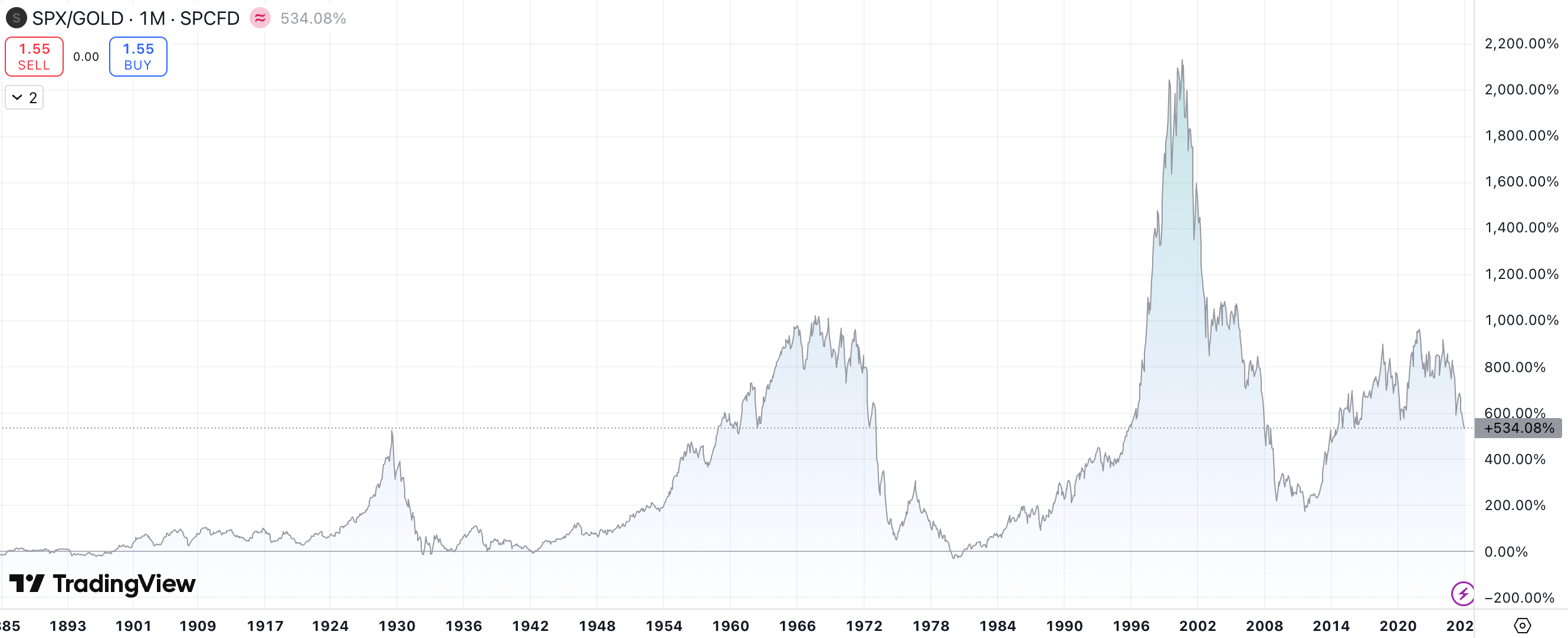
You can see this distortion clearly in historical comparisons. Take the S&P 500 vs. gold from 1970 to 2024, both in terms of price performance and real purchasing power. The “superiority” of equities fluctuates wildly once you remove the dollar as the measuring stick.
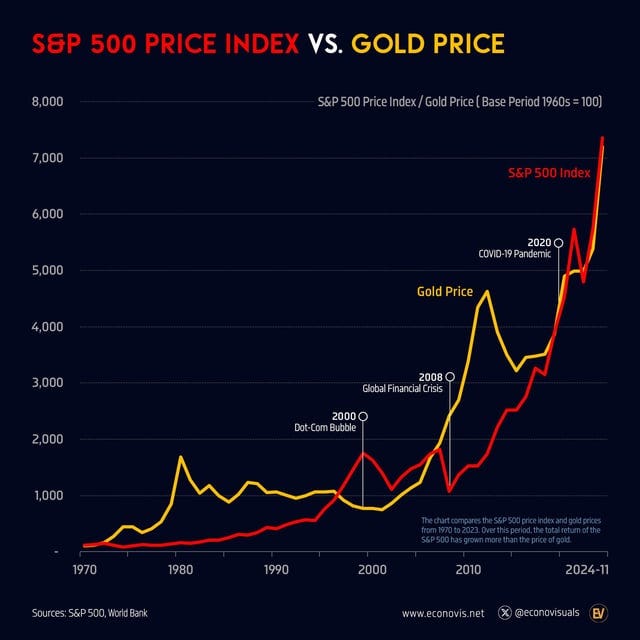
Even in the U.S., adjusted for real inflation, taxes, and drawdowns, returns are more fragile than they seem. The official narrative smooths over regime changes, central bank interventions, and CPI manipulation.
Again: the index only “always goes up” if the measuring tape doesn’t shrink.
So what happens if the dollar is next?
It doesn’t need to hyperinflate or collapse. Just lose 30%, 40%, 60% of its purchasing power over a few decades the way nearly every currency has at some point. Suddenly, all your “gains” are just numbers with less meaning.
This is what most investors miss.
They think they’re investing in companies.
But they’re actually investing in accounting entries denominated in fiat units that may not survive intact.
This is why building a real system of wealth requires stepping back and understanding the meta-game.
Not just choosing the “best stocks” or the “right index,” but choosing what units you want to measure and preserve your wealth in.
Because if you get that part wrong, everything else is noise.
And that, really, is the core of all of this.
Not to say “don’t invest in the S&P 500.”
But to say: let’s stop pretending it’s the universal answer.
Let’s stop playing solitaire and pretending we’re beating the market.
Because if we don’t understand what it means to tie our future to a currency, if we don’t understand what happens when that currency slips, then we’re not investing.
We’re just counting illusions.