It’s the one near the top. The total cost of you. What your employer actually spends to keep you on the payroll: your gross, plus roughly a third again in social contributions you never see. Then income tax is withheld. Then, and only then, money arrives in your account.
By the time you touch a single euro, two parties have already been paid ahead of you. Neither of them asked your permission. Neither of them will ever miss a payment.
That’s the part “pay yourself first” never explains.
Kiyosaki framed it as a discipline problem. Save before you spend. Willpower over impulse. Good advice. It’s also the smaller half of the idea, and the half that keeps people busy for thirty years while the structural half goes unexamined.
Because as an employee, you cannot pay yourself first. Not won’t. Cannot. It isn’t a failure of character. It’s the order of operations, and the order is written into the tax code before you wake up.
You earn. You’re taxed. You spend. You save whatever survives.
A company does the exact opposite. It earns. It spends. It’s taxed on what’s left. And what’s left never has to leave.
Same activity. Same person. Same hours in the day. Different sequence.
The sequence is worth more than the return.
Run it on a single marginal €10,000 of income per year, an extra project, a side revenue line, anything you produce beyond your base:
As salary, in the top Spanish bracket: ~45% gone. €5,500 left to invest.
Inside a company: 15% corporate rate for a new entity (25% general). €8,500 left to invest.
Both compounding at 8% for 20 years:
Employee route: €251,700
Company route: €389,000
Difference: €137,000. Same work. Same market. Same returns.
Nothing in that gap came from being smarter about assets. It came from where the tax sat in the sequence.
The obvious objection is the right one: that money is trapped inside the company. Pull it out as a dividend and you pay again, 19% to 30%. So let’s finish the calculation instead of stopping where it flatters the thesis.
Liquidate everything and distribute it: €389,000 taxed at ~25% on the way out: 292k€
Still ahead of the employee route by 40k€, after paying tax twice.
And that’s the worst case, because the sophisticated version never extracts at all. You borrow against the balance sheet. The 389k stays working. Nothing is realized. Nothing is taxed.
That’s the whole architecture in one line. The employee’s capital is taxed on the way in and again on the way out. The owner’s capital is taxed once, later, and only if he’s careless enough to take it out.
One caveat that matters, and anyone who tells you otherwise is selling something: this works for income you generate, not for salary you relabel. Routing your employment income through a company you control isn’t structure, it’s simulation, and every tax authority in Europe has a specific instrument for it. The vehicle has to sit beside the job, holding real economic activity of its own. That’s not a limitation. That’s the assignment.
Now the harder truth, the one that explains why the order of operations matters so much more than it should.
A salary is the worst asset class you will ever own.
It’s taxed at the highest marginal rate in the entire system, higher than dividends, higher than capital gains, higher than corporate profit.
It cannot be pledged. No bank lends against your future wages, only against things you already own.
It cannot be sold, inherited, or separated from your body.
It stops the day you stop.
Every property of a salary is the inverse of every property of an asset. You’re not building a portfolio with it. You’re renting out your only non-transferable resource at the highest tax rate available, and keeping the residue.
Which is why the arithmetic of freedom on a payslip is so brutal.
€4,000/month of passive income at a 4% net yield requires €1.2M of capital.
On a €55,000 net salary, saving a disciplined 20% (€11,000/year) at 6% real: ~35 years.
Thirty-five years. Start at 28, arrive at 63. The system already had a plan for you and it’s called retirement. You didn’t outmaneuver anything; you executed the default path with unusual discipline and finished on schedule.
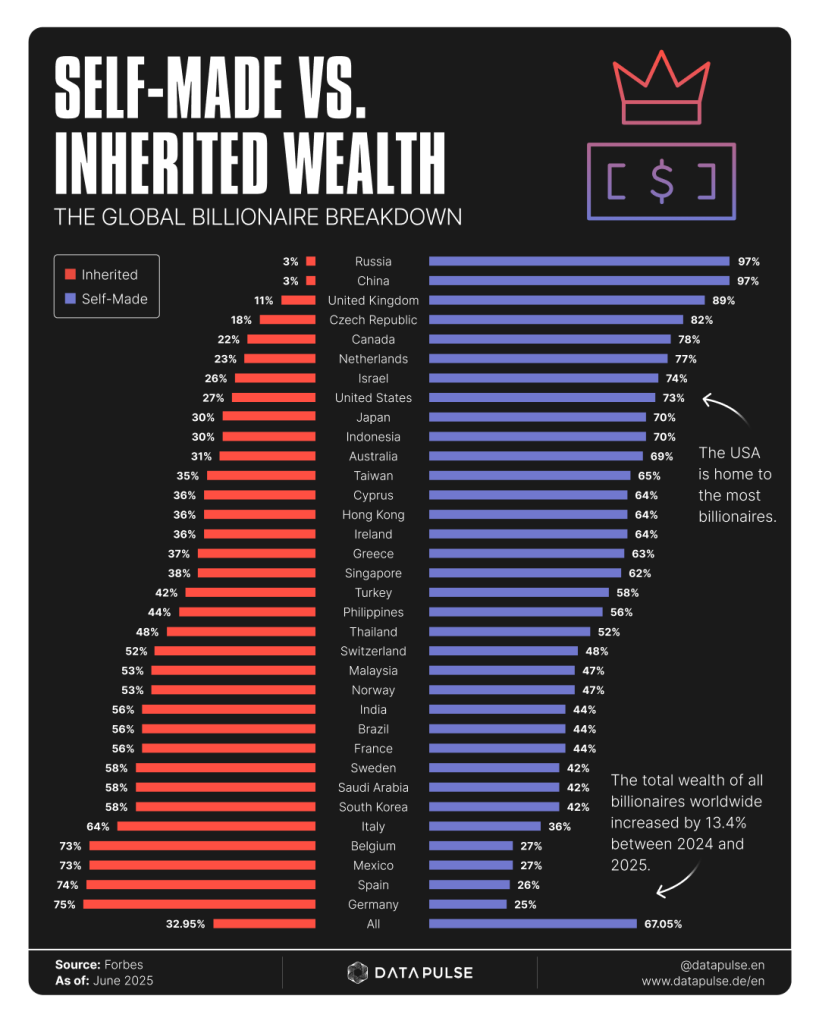
Now look at who actually ends up on the other side. The Forbes 400 of 2025 is worth a record $6.6 trillion, with a $3.8 billion entry bar, and 71% of it is self-made. Globally, roughly two-thirds of billionaires built it rather than inherited it.
Further down, where real life happens: the classic Stanley and Danko work found around two-thirds of American millionaire households headed by self-employed business owners, while the self-employed are under a fifth of the workforce. The Fed’s 2022 Survey of Consumer Finances shows the same shape, close to half of top-decile-income families own a private business, versus 20% of all families. And the top 1% now captures 54% of all capital income, up from 33.5% in 1979.
Read the categories again. Inherited. Founded. Owned. There is no category called employee who saved diligently.
To be fair to the counter-evidence, because it exists: Ramsey’s survey of 10,167 millionaires found engineers, accountants and teachers at the top, 79% with no inheritance at all, a third of them never earning six figures in any single year. Employees absolutely do reach a million euros.
But look at what they reach it with. A retirement account, at sixty-five, denominated in a currency designed to lose value, and a plan to spend it down until they die.
That’s the distinction the whole thing turns on. A salary can make you a millionaire. It cannot make you free. One is a number. The other is a structure that pays you whether or not you show up.
So the practical version isn’t “quit your job.” The job is the cheapest capital you will ever raise (no dilution, no investors, no term sheet). It’s the funding engine. The mistake is letting it be the only engine, and letting every euro it produces enter your life at the back of a queue you didn’t design.
Build the vehicle beside it. Move whatever real economic activity you can generate inside it. Let it pay its own costs before it pays tax. Let the profit stay in and compound, and when you need liquidity, borrow against the stack instead of dismantling it.
Pay yourself first, yes. But pay yourself first in the right order, in the right entity, and in the right money.
Everything else is just saving harder at the end of someone else’s queue.
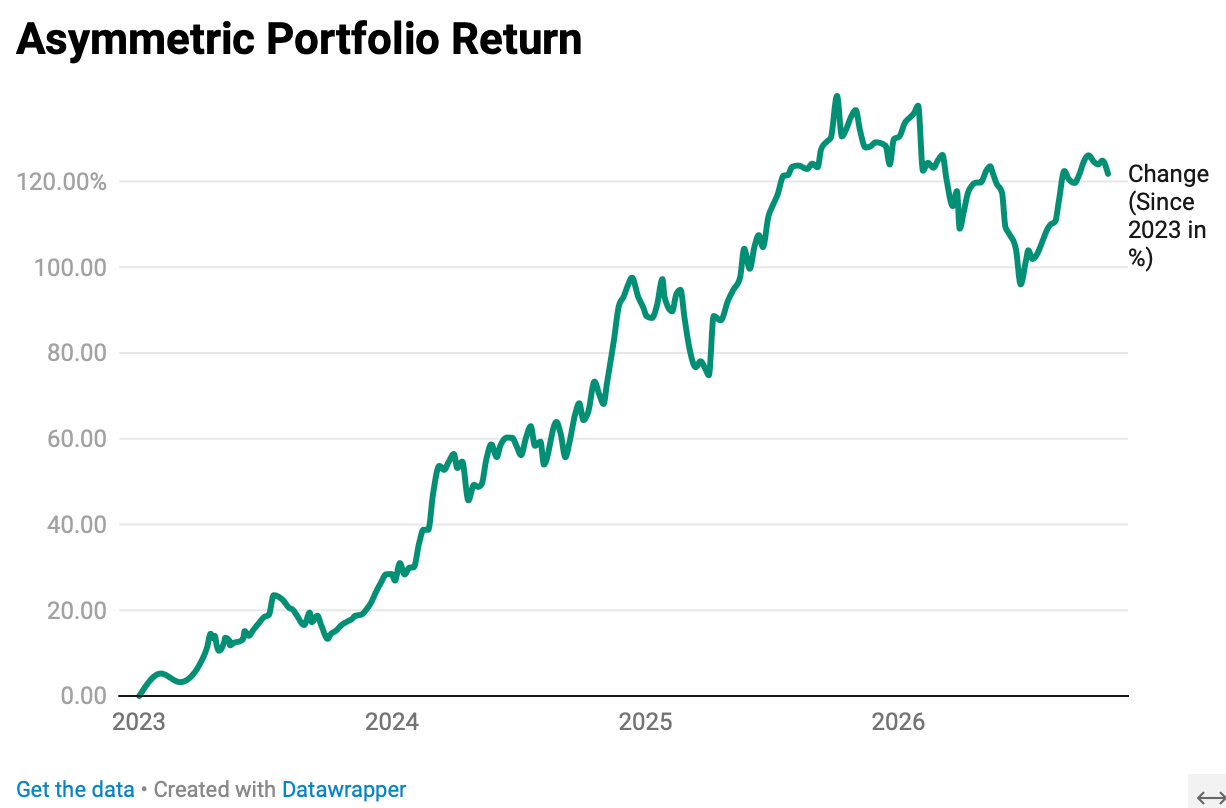
Now our portfolio…
📈 Asymmetric Finance Portfolio
Updated on 30th October