
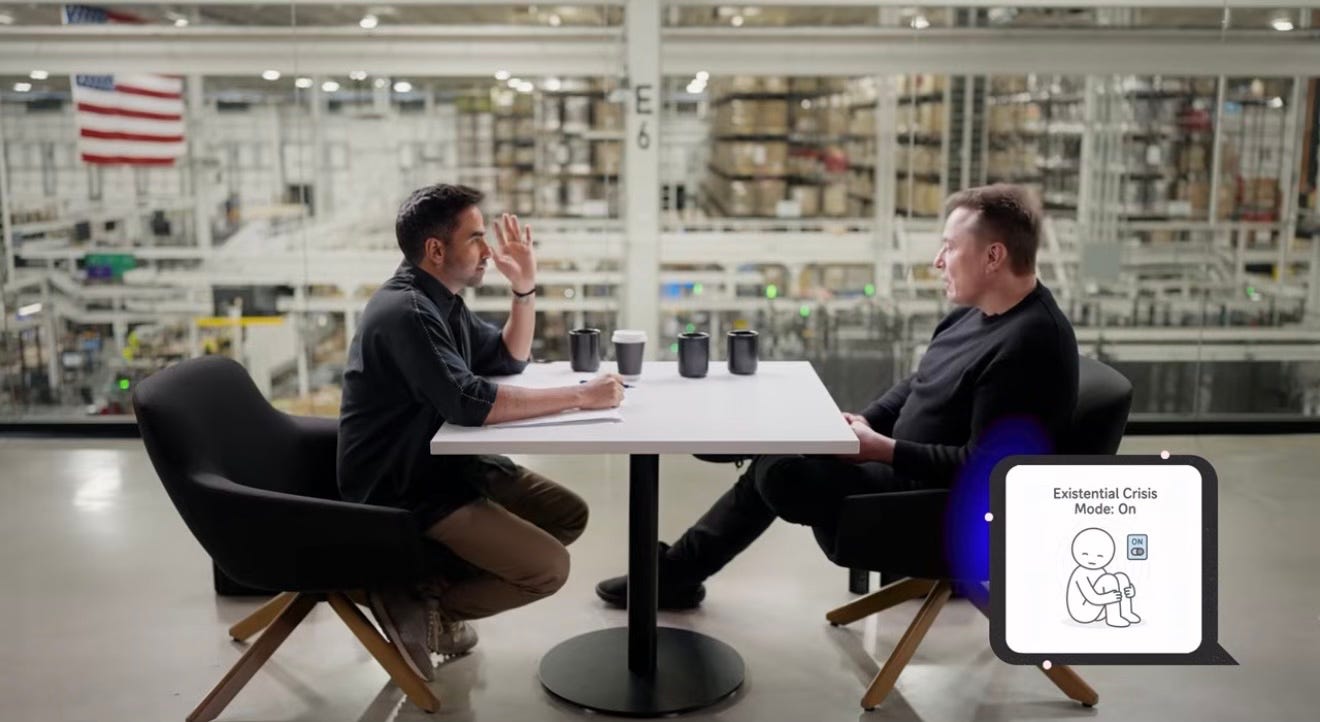
A few months ago, Elon Musk gave an interview that I’ve had on my TO DO list for far too long, and I’ve finally been able to analyze it with the calm it demands.
This isn’t the typical corporate advertorial designed to save Tesla’s quarterly earnings, nor is it a collection of empty soundbites for the mainstream press. It is a warning to sailors. It is one of the most brilliant minds in the world telling you to your face that the operating system of our society is about to be completely reformatted. What Musk unfolds in these two hours is not a tech talk.
It is a survival map.
The conversation starts with a disarming simplicity, between jokes and coffees, but it escalates violently toward concepts that should keep any traditional investor awake at night. Musk doesn’t speculate; he passes sentence. And his first sentence is lethal: money, as we know it, is a fiction with an expiration date.
For him, current money is nothing more than a database for labor allocation. And it is a terrible database.
It is full of latency, errors, political interference, and unpayable debts. In a future of radical abundance driven by artificial intelligence and robotics, where the marginal cost of producing anything tends toward zero, that database ceases to make sense. If robots do everything, fiat money loses its function as a coordinator. It becomes irrelevant.
Here is where he drops the conceptual nuclear bomb.
Energy is the only true currency.
You cannot legislate energy. You cannot print it in a Federal Reserve basement. You cannot counterfeit it with a legal decree nor inflate it to buy votes. In an advanced civilization, the limit to progress is not financial capital; it is the watts we are capable of capturing, storing, and converting into useful work.
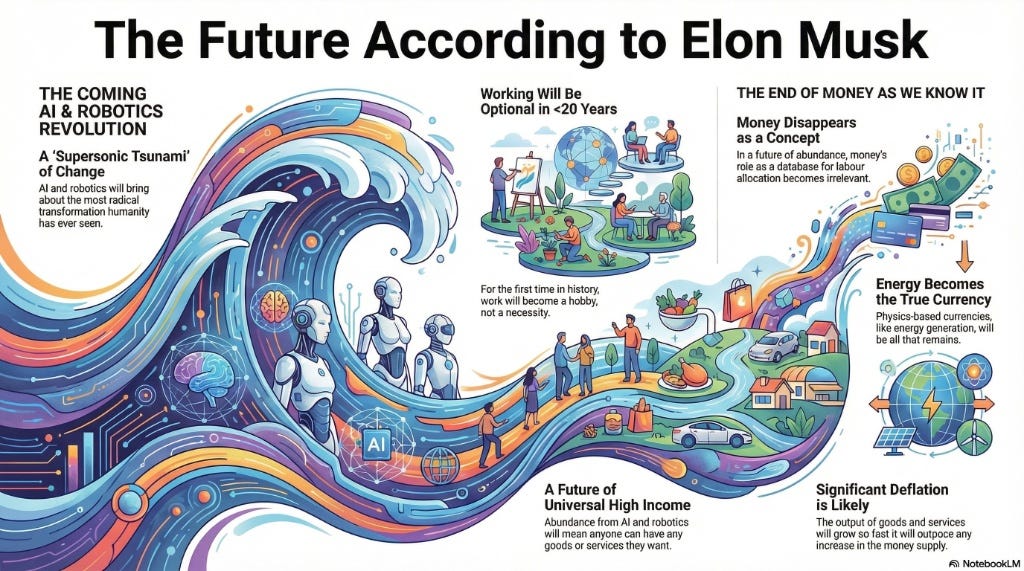
If you look at the image summarizing his vision, you will see that giant wave. It isn’t a pretty drawing. It is a tsunami that will wipe out anyone who continues to think in terms of a “career path” or “savings account.”
Musk is describing, without naming it, the definitive argument in favor of hard money. While the dollar or the euro are political abstractions that melt in your pocket, a system based on energy is immutable physical truth.
The diagnosis he makes of the economy is equally brutal. The United States debt is mathematically unpayable. This isn’t ideology; it is arithmetic. When debt interest payments exceed the defense budget, the game is over.
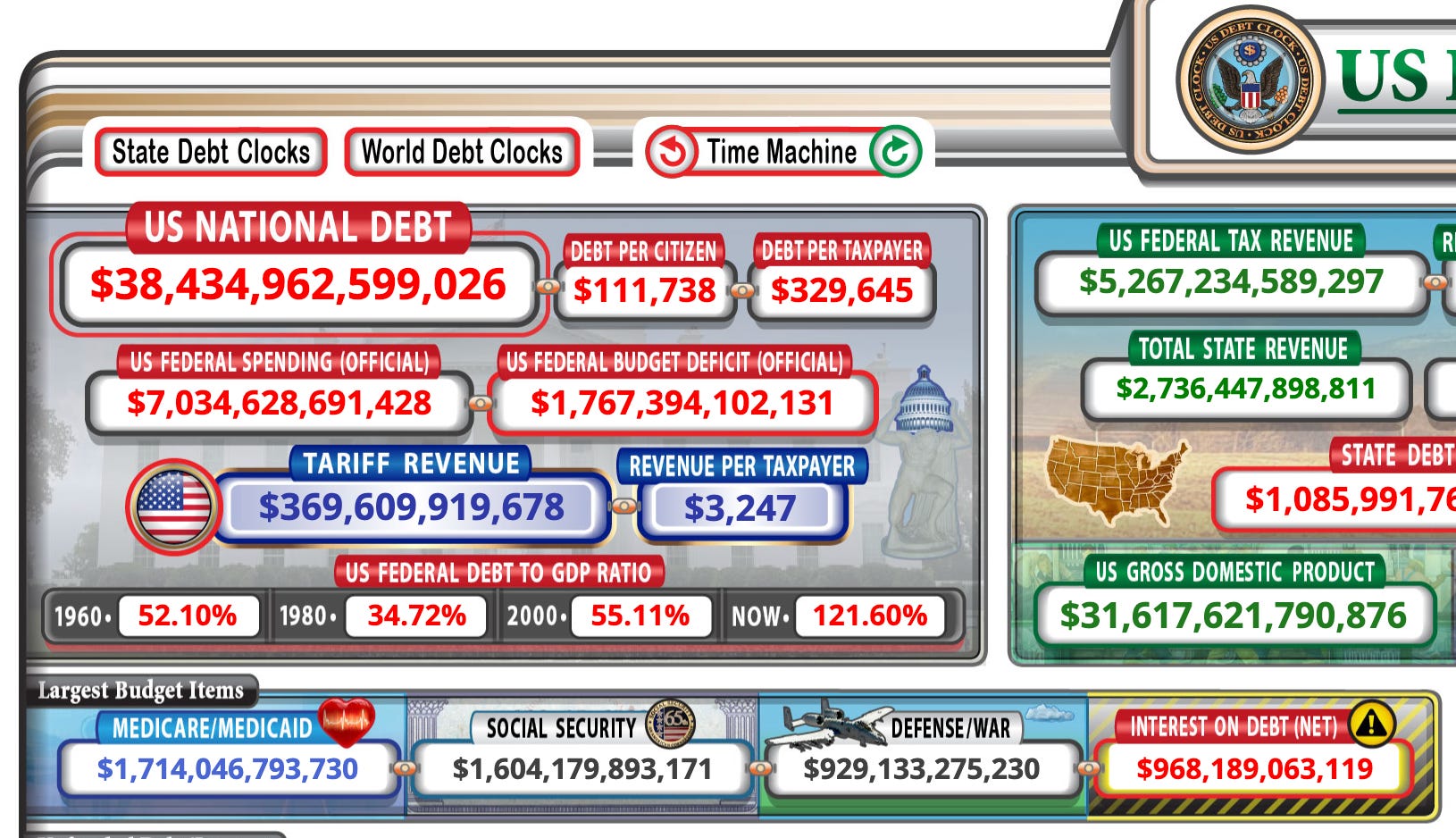
The only exit he sees isn’t austerity (no politician is going to commit suicide by cutting spending) but a flight forward: skyrocketing productivity through AI.
If we manage to make the production of goods grow faster than the degradation of the currency, we will enter a cycle of technological deflation.
Things will be cheaper not because demand collapses, but because artificial intelligence will make them almost free.
If you don’t understand this, your portfolio is going to go to zero in real terms. In a world that is deflationary due to technology, assets that depend on selling artificial scarcity or rents protected by the state are going to be shredded.
Value flees toward infrastructure.
When asked what he would buy if he couldn’t invest in his own companies, Musk doesn’t hesitate for a second: Google and NVIDIA. He doesn’t say it because he likes their charts or their current P/E ratio. He says it because they own the rails of the future. Google has the data and the compute capacity; NVIDIA has the monopoly on the hardware necessary to train the intelligence that will move the world.
He doesn’t invest by diversifying to “reduce risk.” That is for mediocrities. He invests in infrastructure monopolies.
Tesla is not a car company; it is the largest real-world robotics company. SpaceX is not a rocket company; it is the owner of interplanetary transport. Starlink is not a telco; it is the backbone of the internet outside of cities. He sees a total convergence where AI, energy, and space are the same asset.
And this inevitably leads us to Bitcoin, even if he doesn’t say the word.
His thesis of “energy as currency” is the most aggressive validation possible of Proof of Work.
If fiat money is a corruptible database and energy is the truth, Bitcoin is the bridge. It is the only asset in history that transforms pure energy into economic security and digital scarcity.
In a future where governments are going to print to infinity to try and plug the debt hole, holding a store of value that cannot be legislated and is linked to physics is the only real life insurance.
Musk also talks about a “Universal High Income.” He says work will be optional. But be careful with this. He isn’t talking about the State supporting you; he is talking about an era of such abundance that survival will be free. The challenge will be psychological. What do you do when you don’t have to do anything?
Most people will go crazy or get lost in irrelevant digital simulations. Only those with skin in the game, who have built their own systems, will find meaning.
The transition is going to be savage.
Musk reminds us with a smile that “the most entertaining outcome is the most likely.” It is his elegant way of saying that we live in a chaotic simulation where black swans are going to punch you in the face again and again. Stability is a lie.
Stop watching the daily noise. Stop worrying about whether the Fed raises or cuts a quarter point. It is irrelevant.
Focus on owning the assets that own the infrastructure of this new world: energy, compute capacity, and hard money. Do not chase fiat money; chase utility and the ownership of the systems that will generate that abundance. Musk doesn’t play at predicting the market; he builds the tracks the train runs on.
We cannot build rockets, but we can buy the tickets and, above all, not stand on the tracks waiting to get run over.
Here is the operational synthesis so you can stop thinking and start executing: