
In 1494, two kingdoms split the planet with a line on a map. The Treaty of Tordesillas divided the undiscovered world between Spain and Portugal: everything 370 leagues west of Cape Verde for Castile, the rest for Lisbon. Nobody asked the people already living there.
That line is the origin of the modern world. Not democracy. Not the Enlightenment. A line.
Because everything that came after, Westphalia in 1648, nation-states, borders, passports, is the same idea refined: power is exercised by enclosing territory and coercing whoever stands inside it. The state is nothing more than a monopoly on violence over a parcel of land. It works because you, your house, your factory and your gold sit physically inside the parcel. You can’t flee carrying a factory on your back.
For five hundred years, that model captured everything. Every square meter of dry land today has a flag on it.
But two spaces were never enclosed.
Cyberspace and outer space. The two territories no Tordesillas line could divide. The Outer Space Treaty of 1967 states explicitly that no nation may appropriate the Moon or any celestial body. And cyberspace never had a treaty at all, only protocols. Nobody ever signed sovereignty over TCP/IP.
And here the interesting question appears: what is scarce in a territory without borders?
In cyberspace, almost nothing. A photo sent fifty times is fifty photos. Copying is free; abundance is the default. That’s why for decades nothing digital could be money, money demands scarcity, and the digital was infinitely replicable. Until 2009. Bitcoin is the first natively scarce object in cyberspace. Twenty-one million units, verifiable, unconfiscatable by territorial occupation. It is, quite literally, the first property that exists beyond the reach of Tordesillas.
In outer space, the problem runs in reverse. If we find gold on the Moon tomorrow, and it’s there, along with platinum in near-Earth asteroids, terrestrial gold stops being scarce by geology and becomes scarce only by extraction cost. Gold’s scarcity is an accident of depth. Bitcoin’s is mathematical. One of the two pillars of hard money has a technological expiry date. The other doesn’t.
Now connect the pieces. The state collects because it coerces, and it coerces because your assets sit inside its parcel. But every year a growing fraction of the world’s wealth migrates to where the parcel can’t reach: private keys, neutral networks, capital crossing borders at the speed of a block. Violence doesn’t work against twelve memorized words.
Does this mean the state surrenders? No. It means it changes prey.
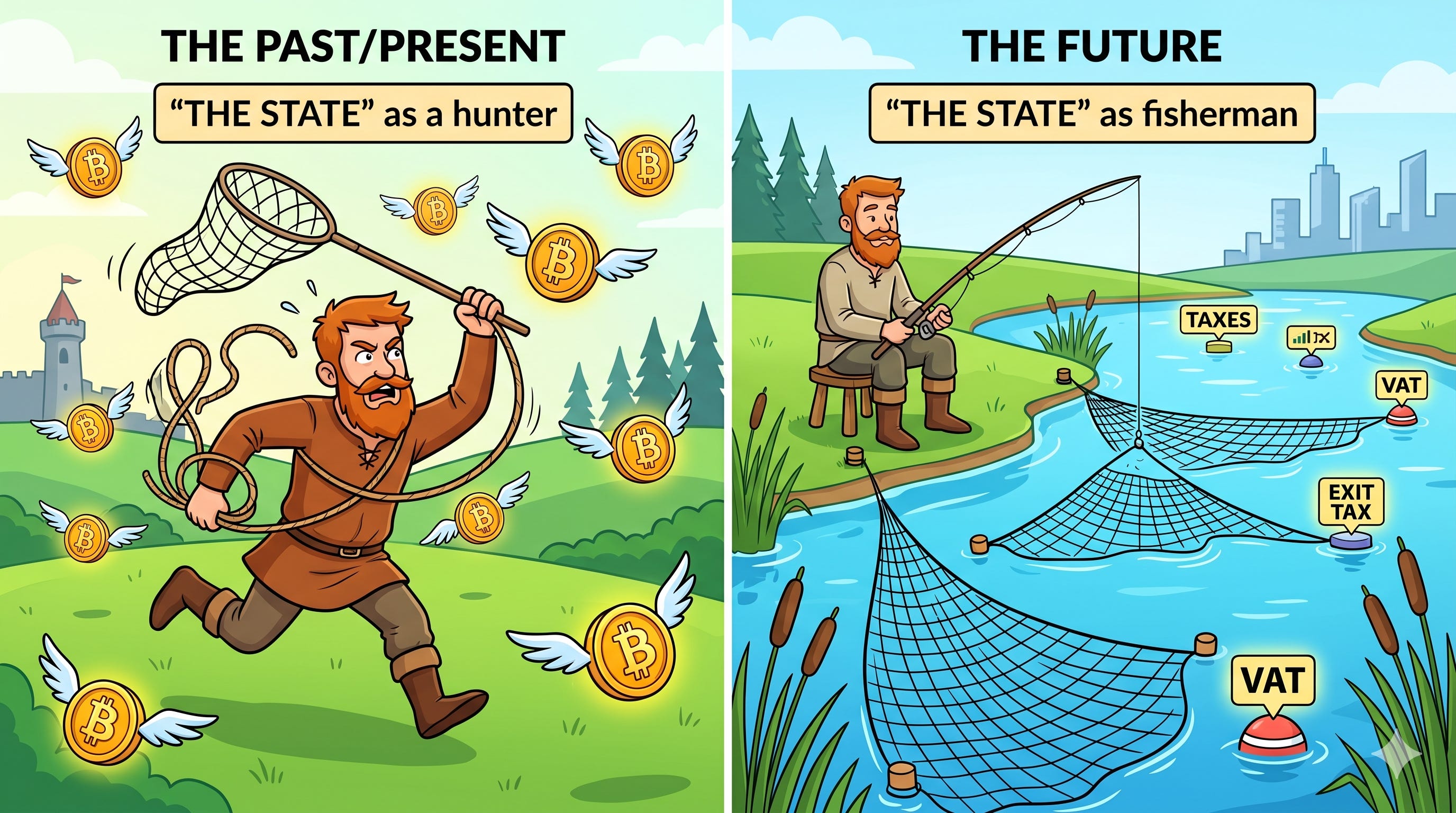
When you can’t tax the asset, you tax the interface, the contact points between cyberspace and the physical world: exchanges, banks, fiat on-ramps, automatic reporting frameworks now spreading across every major jurisdiction. These aren’t taxes on Bitcoin. They’re tolls on the border between two worlds.
And when that isn’t enough, states will turn to what cannot flee:
Land and property. The original hostage. Recurring property taxes, land value levies, reassessments. A house has no private keys.
Consumption. Every economy taxes the act of living somewhere: VAT, sales tax, excise duties. You can hide capital; you can’t hide groceries.
The body. Residency-based and citizenship-based taxation. As long as you physically stand inside the parcel, you’re the asset.
Movement itself. Exit taxes on unrealized gains when you leave. The fiscal Berlin Wall: when you can’t retain capital, you charge it for leaving.
Energy and infrastructure. Electricity, fuel, roads, bandwidth. Whatever the digital world needs from the physical one becomes a chokepoint.
Inheritance at the border. Death is the one interface everyone crosses. Estates that touch the physical world get taxed on the way through.
The future I imagine isn’t the collapse of the state. It’s its transformation from hunter into fisherman. It will no longer chase your wealth across the hills; it will set nets in the rivers that wealth must pass through. And the individual game will consist of needing to cross the river as few times as possible.
That’s why the strategy isn’t hiding. It’s designing a life where almost all your wealth lives in the territories Tordesillas never reached, and only the minimum indispensable flow touches solid ground. Accumulate in cyberspace. Live on the smallest possible stream in the physical world. Let the state tax the interface and make the interface small.
The lines on the map are still there. They just no longer contain the whole map.
Now our portfolio…