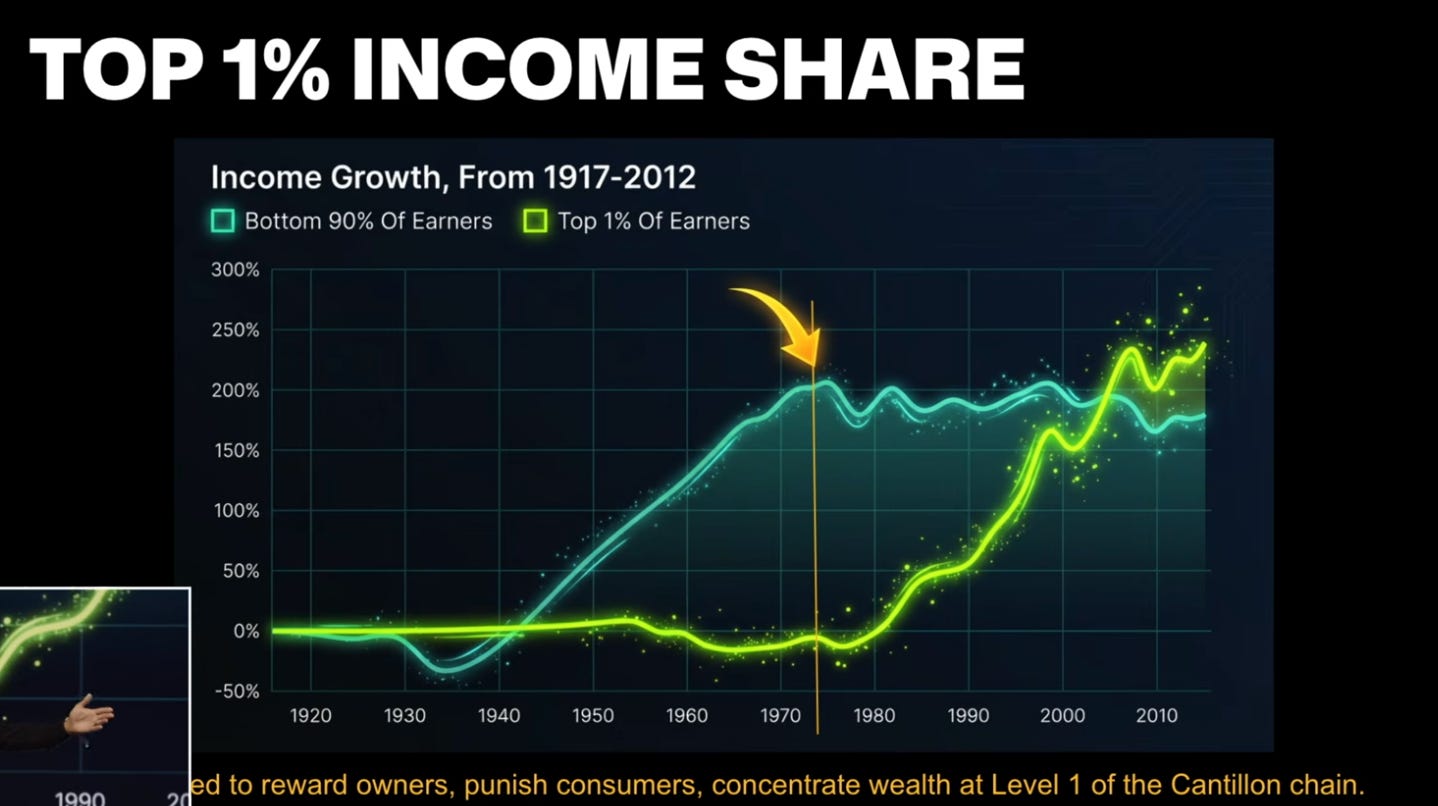
Last week a friend who runs a family office wanted to introduce me to a guy who moves serious money in fixed income. He knows every curve, every name, every market rotation.
I said no.
And I told him why, because it felt important. I’m increasingly convinced that the question almost everyone asks when they talk about investing is the wrong question. It’s not whether the next winner will be Nvidia or Tesla. It’s not which sector to rotate into. It’s not when the institutional money flows in.
It’s something else. Simpler. More uncomfortable.
When and how did you get the capital?
That question (the one almost nobody asks) accounts for 90% of the outcome of your financial life. Stock picking is noise. The real melody runs underneath. And it has a name, described by an Irish economist in the 18th century and buried by modern academic finance because it doesn’t generate fees.
The Cantillon effect.
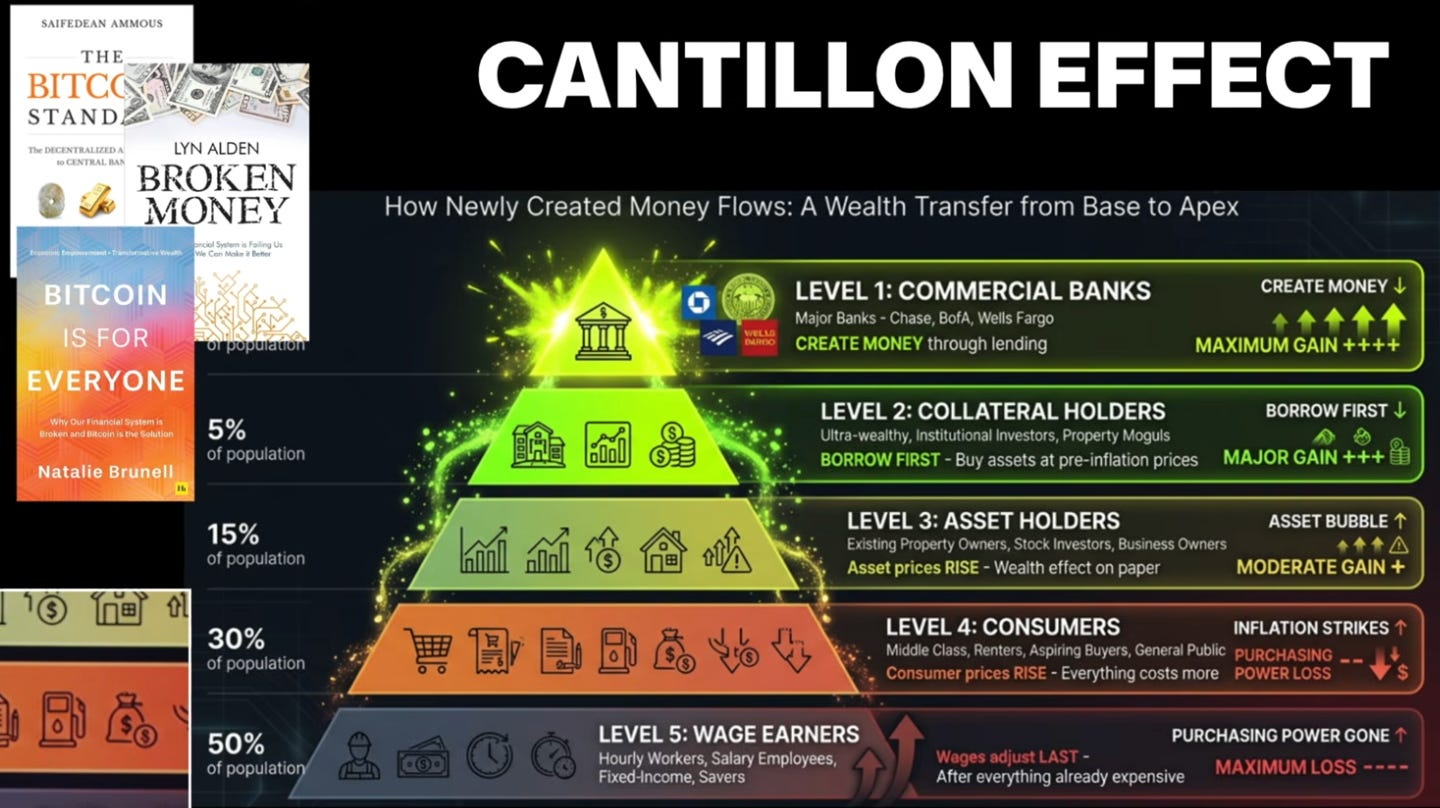
The idea isn’t complicated. When new money is created and it’s created constantly, not as an exception but as a structural mechanism of the system, it doesn’t land evenly across the economy. It enters at the top. Through commercial banks. Through collateral holders. Through asset owners.
Then, much later, it filters downward. To consumers. To wage earners. To savers in checking accounts.
And by the time it reaches the bottom, the assets have already moved up.
The one at the top buys assets at pre-dilution prices. The one at the bottom buys the same assets at post-dilution prices. Both did what the textbook said. But one entered before the inflation and the other entered after.
It’s not picking. It’s positioning.
This is what an index fund doesn’t solve for you. An index fund solves the question of which assets to hold. It doesn’t solve the question of when to hold them. And in a system designed to dilute, the when is everything.
Let’s look at the numbers. Charts persuade. Numbers nail it down.
Two people. Same starting point: 100,000 euros today. Same conviction in the long term. Same asset mix, a serious blend of global equity, gold, and Bitcoin that we’ll assume returns 12% nominal annually. Same discipline.
The only difference is the architecture they choose to deploy that capital through.
Person A: Cantillon Level 2 (dynamic 50% LTV):
Day 1: invests her 100,000€ at 12%
Day 1: borrows another 100,000€ against her assets at 3% and invests it. Initial portfolio: 200,000€. Initial debt: 100,000€. Initial LTV: 50%
Each year, as her assets grow, she rebalances: draws additional debt to keep LTV constant at 50% and reinvests it
Mechanically, her equity compounds at 21% annually (12% on 2× assets minus 3% on 1× debt)
Net worth at 30 years: ~30.4 million euros (gross assets ~60.9M, outstanding debt ~30.4M, debt being paid back in increasingly diluted money)
Person B: the disciplined saver:
Day 1: invests her 100,000€ at 12%
Saves and invests 333€/month over 30 years (another 100,000€ contributed across time, entering the market gradually)
Net worth at 30 years: ~4.16 million euros
Same return. Same asset. Same own capital deployed: 100,000€ each on day 1, plus another 100,000€ over the 30 years. Person A isn’t richer at the start. She just understood earlier that the system rewards capital that is already working, not capital being slowly fed in.
Difference at the end: 26 million euros. Roughly 7×.
This model is idealized, sustained 50% LTV requires real discipline, real liquidity buffers, and the stomach for drawdowns that in the real world can trigger margin calls if your structure is sloppy. But the principle stands. The architecture itself is what compounds. And there, in those 26 million, sits the Cantillon effect applied to your life. Not to a country. Not to an abstract social class. To you, the individual, deciding how to organize your balance sheet today.