

The other day I read the story of the Winklevoss twins
For anyone who doesn’t know it: Cameron and Tyler. The ones who fought Mark Zuckerberg over the ownership of Facebook. They said the idea was theirs. They ended up signing a 65 million dollar settlement, 20 in cash and 45 in shares
And here’s the interesting part. That’s not what made them billionaires
They became billionaires because they took that money and put it into Bitcoin when it traded at a little over a hundred dollars. Then they built Gemini, one of the best known exchanges in the world. And a card you obviously can’t try in Europe, but that I’d love to try, because the cashback is not bad at all.
They lost the battle. They won the war on a different board
And now those same brothers have spent a while talking about something else. About Zcash. They’ve set up a Nasdaq-listed company, Cypherpunk Technologies, dedicated to accumulating ZEC the same way Saylor accumulates Bitcoin. Stated target: 5% of the entire supply. And a few months ago they also fired up a mining fleet that now takes roughly 18% of the network’s hashrate
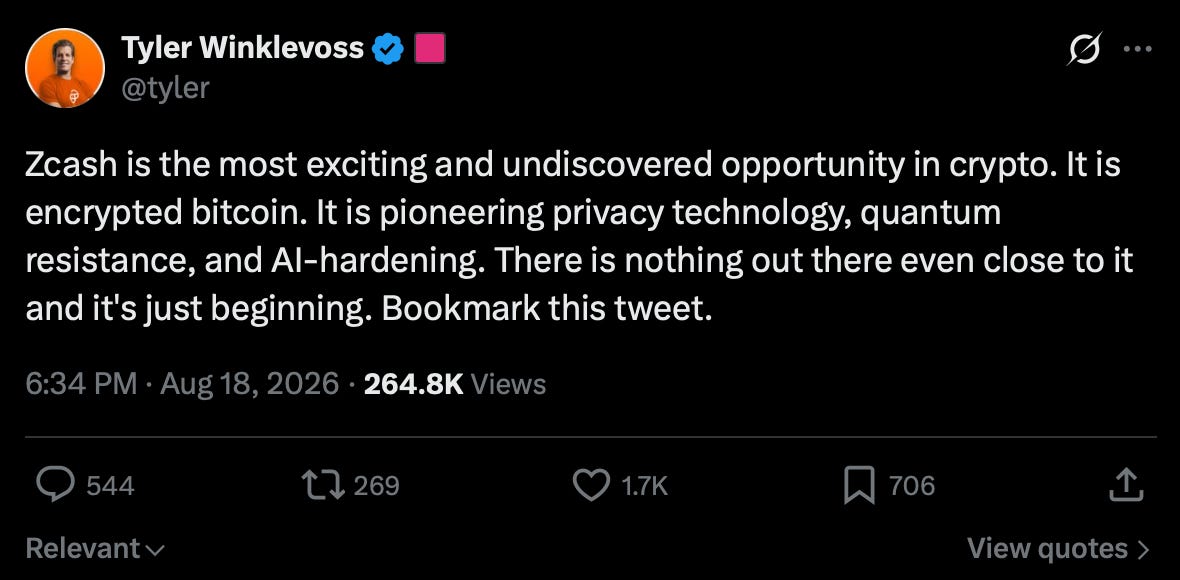
When I read that, something came to mind that comes to mind quite often
That as we get older we pick up patterns. And getting out of those patterns is brutally hard
Think about it for a second. Our grandparents never got out of fixed income. Neither did our parents, or at best they made it to equities and stopped there. We’ve leveraged ourselves to real estate, or to Bitcoin, or to whatever worked for us once. And the better it worked, the less capable we are of hearing what comes next
We’re not leveraged to assets. We’re leveraged to our beliefs
That’s the real trap. The bias doesn’t come from having been wrong. It comes from having been right
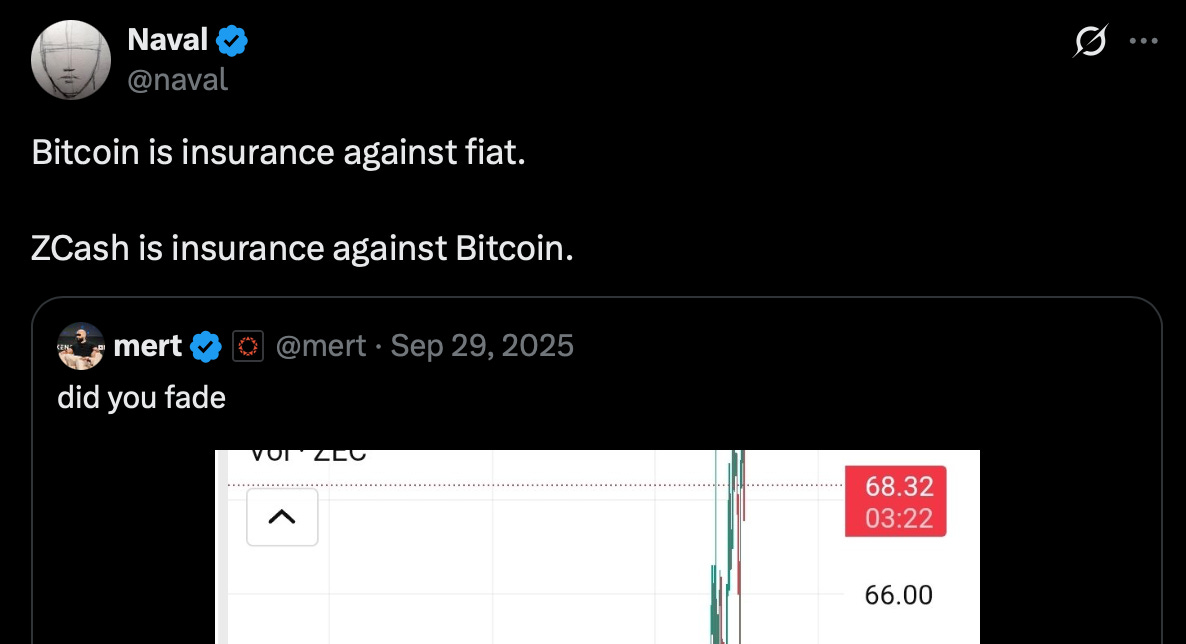
And right then I remembered a Naval Ravikant tweet, from about a year ago, that went something like this: Bitcoin is insurance against fiat, Zcash is insurance against Bitcoin. Five words that moved the price 60% in a day. I’m not bringing it up as an investment argument. I’m bringing it up as an attention argument
So I said, fine, let me listen