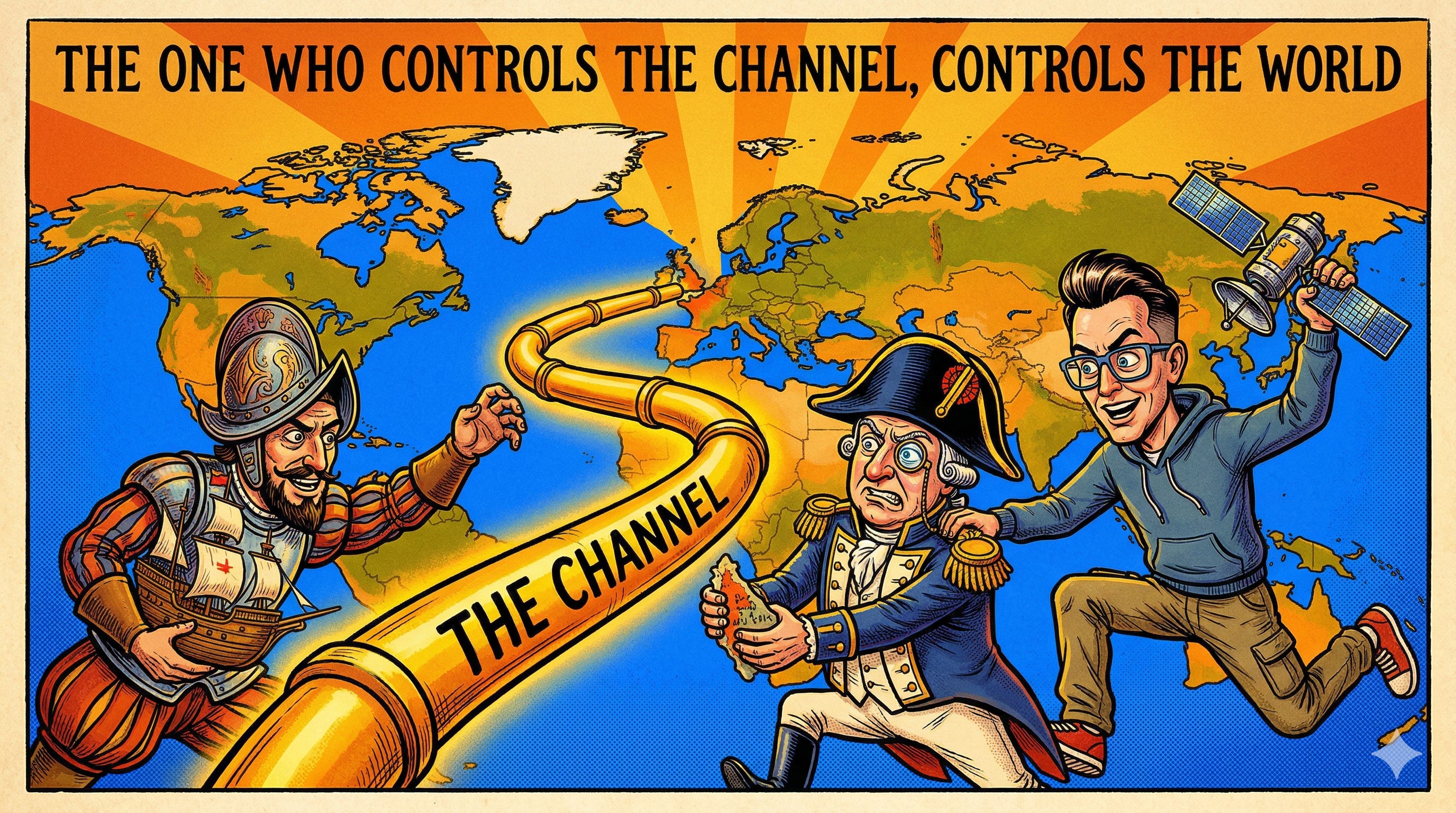
The One Who Controls the Channel, Controls the World
The Real Monopoly Isn't the Product
There is a pattern that repeats throughout history with an almost irritating precision. The century doesn’t matter. The technology doesn’t matter. The language in which power speaks doesn’t matter.
Whoever controls the route, wins.
Always.
When Philip II sent his galleons loaded with American silver, it wasn’t the gold that made Spain the dominant power of the sixteenth century. It was that no one else could cross those routes without permission. The distribution channel was the Atlantic Ocean, and Spain held the keys. Later, the British understood the game better than anyone.
They built the most powerful navy in the world not to explore, but to control. Gibraltar is not a geographic accident in British foreign policy. It is a position of absolute control: through a fourteen-kilometer strait pass all the ships that enter the Mediterranean. If you are the gatekeeper, you don’t need to own anything else. You collect simply by existing.
That is a distribution monopoly. And it is the only monopoly that truly matters.
Peter Thiel described it in Zero to One in a way that should be mandatory reading for any business analysis: the goal of a company is not to compete, but to stop competing. A monopoly is not a market aberration. It is the signal that someone solved something so definitively that the rest of the field became irrelevant. But Thiel was talking about product. I am talking about something deeper: control over the channel through which everything else flows.
Blockbuster didn’t die because its movies were bad. It died because the distribution channel stopped being the physical store and became the internet. Netflix didn’t invent entertainment. It invented a way of delivering entertainment that made the competitor’s geographic position irrelevant. The real asset wasn’t the catalog. It was the pipe.
The same happened with the newspaper. For two centuries, whoever controlled the printing press and the delivery trucks controlled information. Distribution was expensive, slow, physical. That created entry barriers that were nearly insurmountable. Then the internet arrived, the cost of distribution collapsed to zero, and with it collapsed the business models of almost every traditional media outlet. Not because people stopped wanting information. But because anyone could distribute it.
The pattern is always the same: as long as the distribution channel is yours, the business is yours. The moment the channel changes, you lose everything, even if the product is identical.
Oil taught this lesson in the most brutal way possible. The Strait of Hormuz is not a financial concept. It is a physical point through which approximately twenty percent of the world’s oil passes. When Iran blocks or threatens to block that channel, it is not conducting foreign policy. It is exercising the only power it has: being the gatekeeper of a pipeline the world cannot ignore. It doesn’t need to win a war. It only needs the channel to be important enough that no one dares close it entirely.
That is where the real asymmetry of geopolitical power resides.
And now comes the question that should keep you awake if you think in decades rather than quarters: which distribution channel is changing hands right now?
There are two answers. One geopolitical. One monetary.
The geopolitical one: low Earth orbit. Near-Earth orbits are no longer the domain of states. They are the domain of whoever can launch satellites. And whoever has enough satellites in low orbit controls global communications, GPS systems, surveillance of any point on the planet, and, this is what almost no one mentions, the ability to deny those same advantages to any other actor.
Whoever dominates low orbit in the coming decades will not have won a conventional war. They will have won the channel. Just as Spain did with the Atlantic. Just as Britain did with the Mediterranean. The question is not who has more missiles. It is who can block the other’s access to the sky.
The monetary one: money is also a distribution channel.
For centuries, the channel was physical. Gold, silver, copper coins. Whoever controlled the mint controlled who could participate in the economy. Then came paper money backed by metal. Then paper money without backing. Then international interbank networks: SWIFT, correspondent banking, the invisible infrastructure that moves money across borders. The United States understood this with brutal clarity: whoever controls the global settlement system holds a power no army can match. Sanctioning Russia from SWIFT was not a military act. It was an act of channel control.
The problem for any hegemon that controls a distribution channel is always the same: the channel doesn’t last forever.
Bitcoin is the first time in history that a monetary distribution channel exists that cannot be confiscated, cannot be blocked by a state, and requires no permission from any intermediary to function. This is not a technological promise. It is a property of the protocol. And those who understand the history of power not conventional economics, but the deep pattern of who wins and why, see in that something that goes far beyond speculation.
Currencies don’t triumph because their economies are better managed. They triumph because their distribution channels are more resilient. The dollar is not the world reserve currency because the American economy is the best run. It is the reserve currency because when the world needs to settle debt, it does so in dollars, and dollars are only created in one place. That is channel control.
History doesn’t repeat itself. But it rhymes with unsettling precision.
The pattern has always been the same: identify the channel no one can avoid, control it before others understand what it is, and hold that position for as long as it lasts. When the channel changes (and it always changes) whoever reacts too late loses everything. Whoever saw it coming had already built the next position.
That is how the Spanish won in the fifteenth century. How the British won in the eighteenth. How the United States won in the twentieth.
The question is not which asset to buy. The question is which channel is forming right now. And whether you are still in time to be on the right side of it.


