I’ll admit it. I can’t keep up
I wake up, open my phone and there’s a new model. A new feature. An agent that does something today it couldn’t do yesterday. I test it, take notes, tell myself I’ll plug it into my routine tomorrow. And tomorrow something else is out
Naval has been warning for a while that AI would create anxiety. Because of the speed. That constant feeling of being late to everything
I thought that would happen to other people. The ones who don’t read, who don’t pay attention
Well. It’s happening to me
And the worst part isn’t the feeling. It’s the gut sense that this won’t get better. Every month moves faster than the last. Still, I’m convinced this is the wave that changes everything, so there’s no choice but to try and surf it, even if it keeps knocking me over
A few days ago I saw something that stopped me cold.
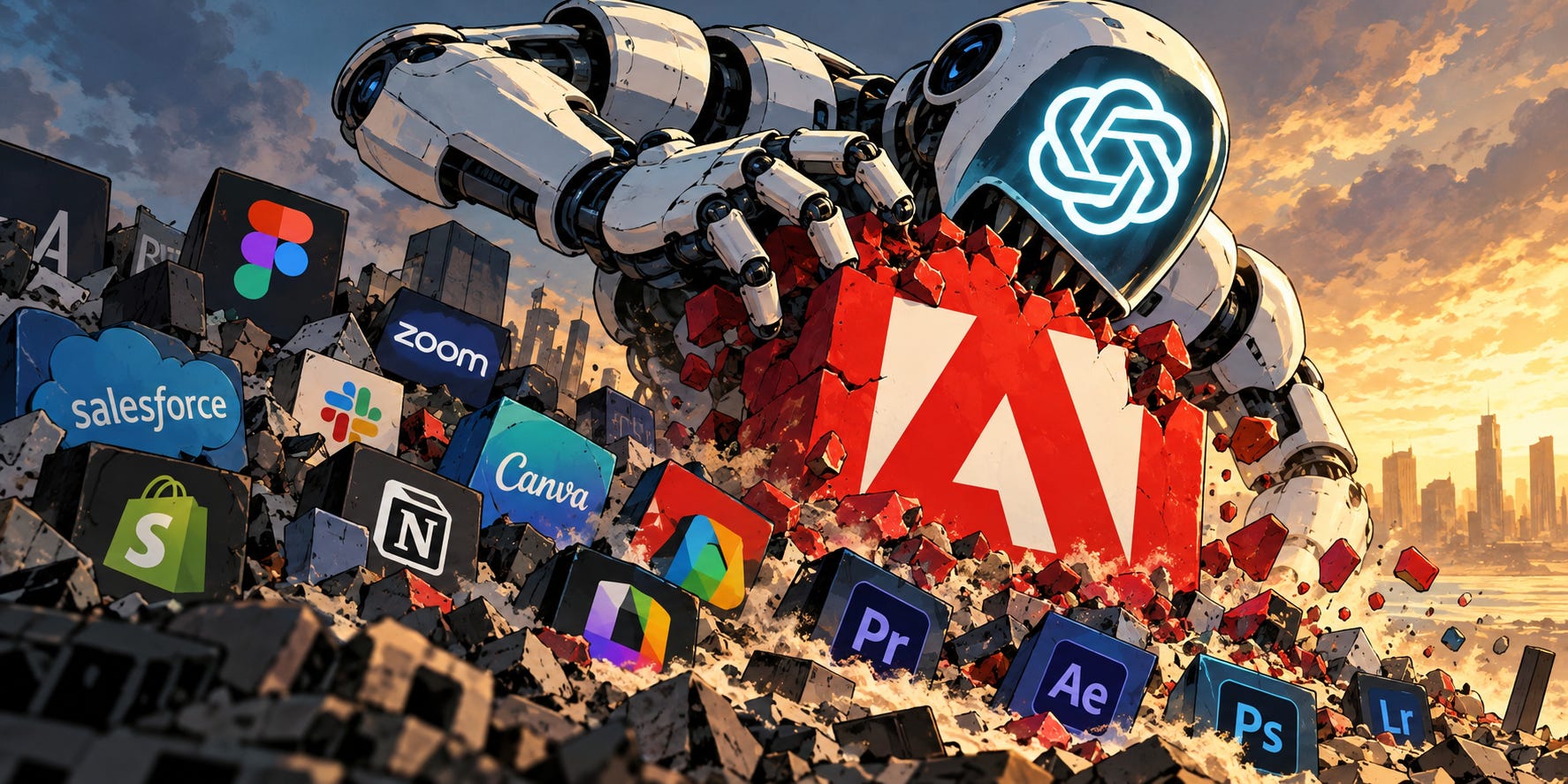
A developer named Brandon Thomas, fed up with Adobe’s cancellation fees (if you’ve paid one, you know), did what anyone with patience and a good model can do today. He used AI to recreate seven Adobe apps. Photoshop, Illustrator, Premiere, Lightroom, After Effects, InDesign and Acrobat. Same interfaces, same keyboard shortcuts, without touching a single line of Adobe’s code
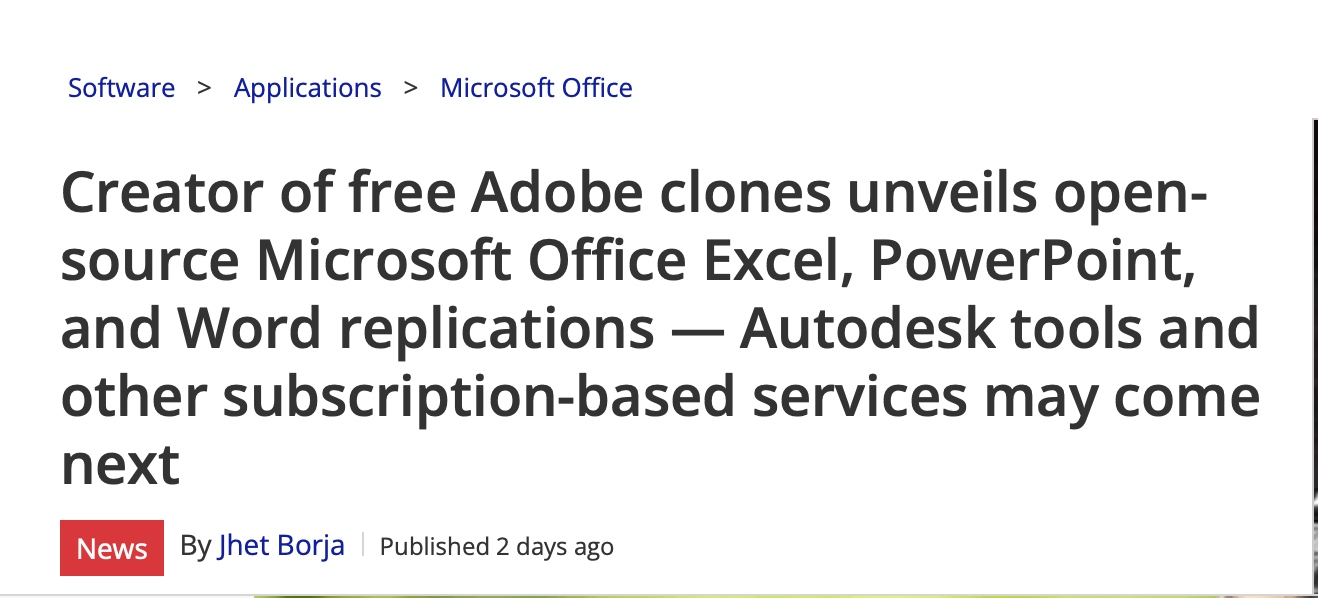
Free. Open source. His verdict: software is over
Do they work like Adobe? No. Let’s be honest, early users have already found problems and nobody is building a design agency on this tomorrow morning.
But that’s not the question.
The question is what it means when one angry person can replicate in weeks what took Adobe thirty years and thousands of engineers. Even at 70%. Even with bugs. Because in a year there will be fewer bugs. And in two...
The market has already answered
Adobe is down more than 30% in 2026 and over 60% below its 2021 highs. And here’s what almost nobody mentions. The company keeps beating estimates. Revenue growing 12-13%. Operating margins above 35%. Around $9 billion in free cash flow a year
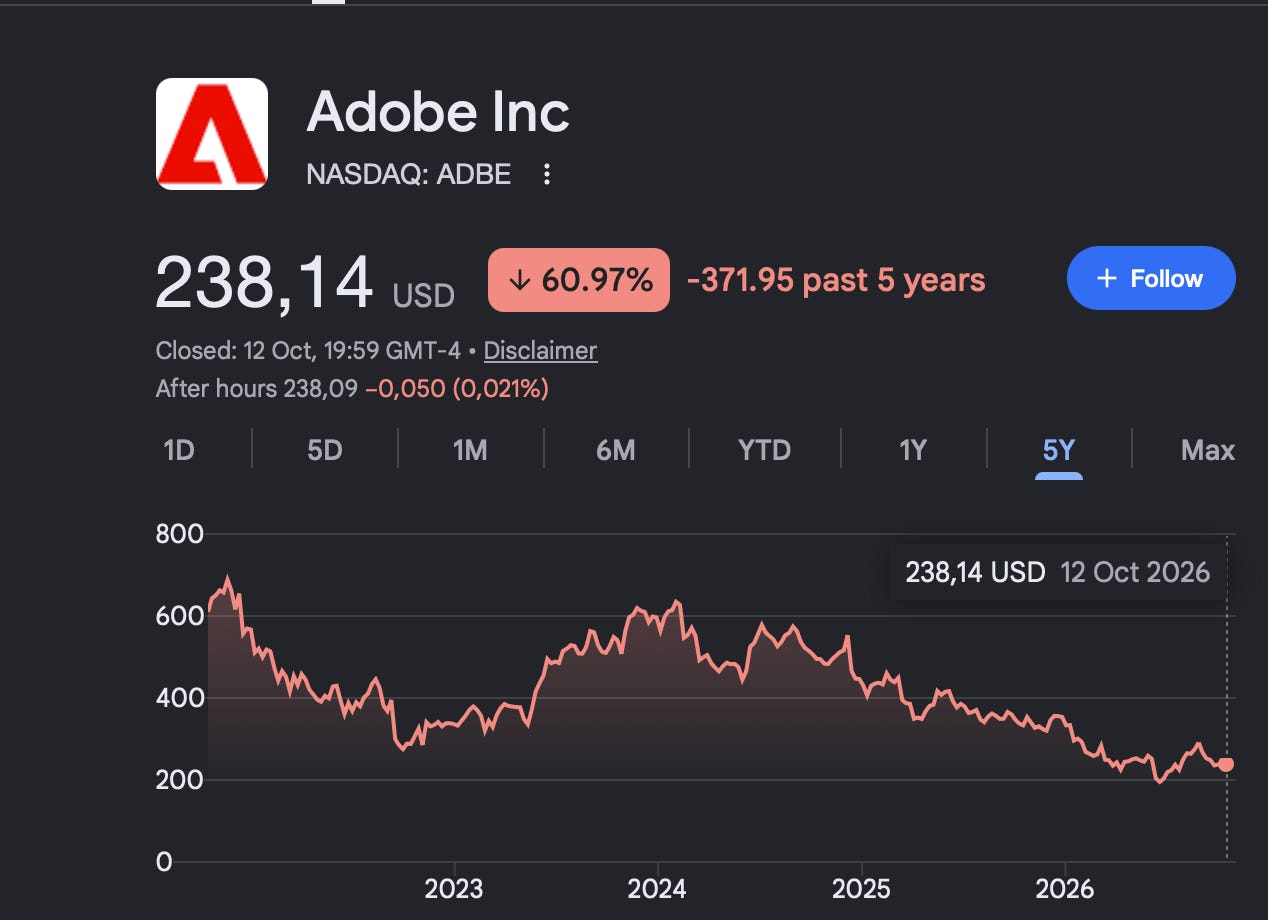
And its trading at roughly 9 or 10 times forward earnings. Like a tobacco company
Why?
Because the market doesn’t pay for what you earn today. It pays for what it thinks you’ll earn in ten years. And it’s saying, loud and clear, that it no longer believes software will grow at double digits forever
This is what some people now call the SaaS-pocalypse, and I’ve been saying it would come for a long time. The S&P 500 software index fell 20% in the first months of the year. Plenty of application names dropped between 30% and 55%.
Adobe is simply the most visible because its product is the easiest to understand. Everyone knows Photoshop. Everyone has watched an AI generate an image in ten seconds.
But the pattern repeats everywhere.
Look at Salesforce. It closed its last fiscal year with $41.5 billion in revenue, up 10%, and the stock has lost roughly a third of its value this year. The fear is very specific. If an AI agent does the work of ten people, you don’t need ten licenses. You need one. Or none
My thesis is simple. The SaaS giants won’t disappear. They have huge customers, multi-year contracts, data, integrations nobody wants to touch. They’ll keep making a lot of money.
But they’re going to look more and more like SAP or IBM. Mature, profitable companies defending margins by cutting costs and buying back shares, while watching the price of every license drift lower year after year. And saying goodbye to the double-digit growth we got used to over the last decade
This hits everyone. Your index fund, which is full of software. Your pension. Anyone who bought “tech” thinking it meant infinite growth
And what comes next is even more interesting.
The day AI gets a bit more reliable, and that day isn’t far, every company and almost every person will be able to build their own custom software. A CRM with exactly what you use and nothing else. A photo editor that does the three things you need. No subscriptions, no cancellation fees, no asking anyone for permission
When something can be copied infinitely at near zero cost, its price goes to zero. It happened to music. It happened to news. Now it’s software’s turn, and hardware after that
And here’s the part I actually care about as an investor.
If everything digital trends toward abundance, value moves to what can’t be copied.
You can’t prompt a model to generate more land. Or more gold. Or more bitcoin. Bitcoin isn’t physical, sure, but it has something no line of code ever had: a limit nobody can override. 21 million. Not Adobe, not OpenAI, not the Federal Reserve
I think AI will create an enormous number of millionaires. People who use it to produce ten times more, to build one-person companies, to do in a weekend what used to take a year. You have to be there. You have to use it every day, even if it makes you anxious, even if you can’t keep up with everything.
But creating wealth and keeping it are two different games
AI can make you rich. Scarcity is what keeps you rich
So I play with both hands. With one, all the productivity I can squeeze out of these models. At work, in this newsletter, everywhere. With the other, my wealth far away from anything AI can replicate. Land, gold, bitcoin. Things that don’t depend on someone renewing a subscription
The great irony of this revolution is that the faster the digital world runs, the more valuable the things that don’t move become.
If you watched Adobe fall this year and thought it was an Adobe problem, open your portfolio and count how much of it can be copied
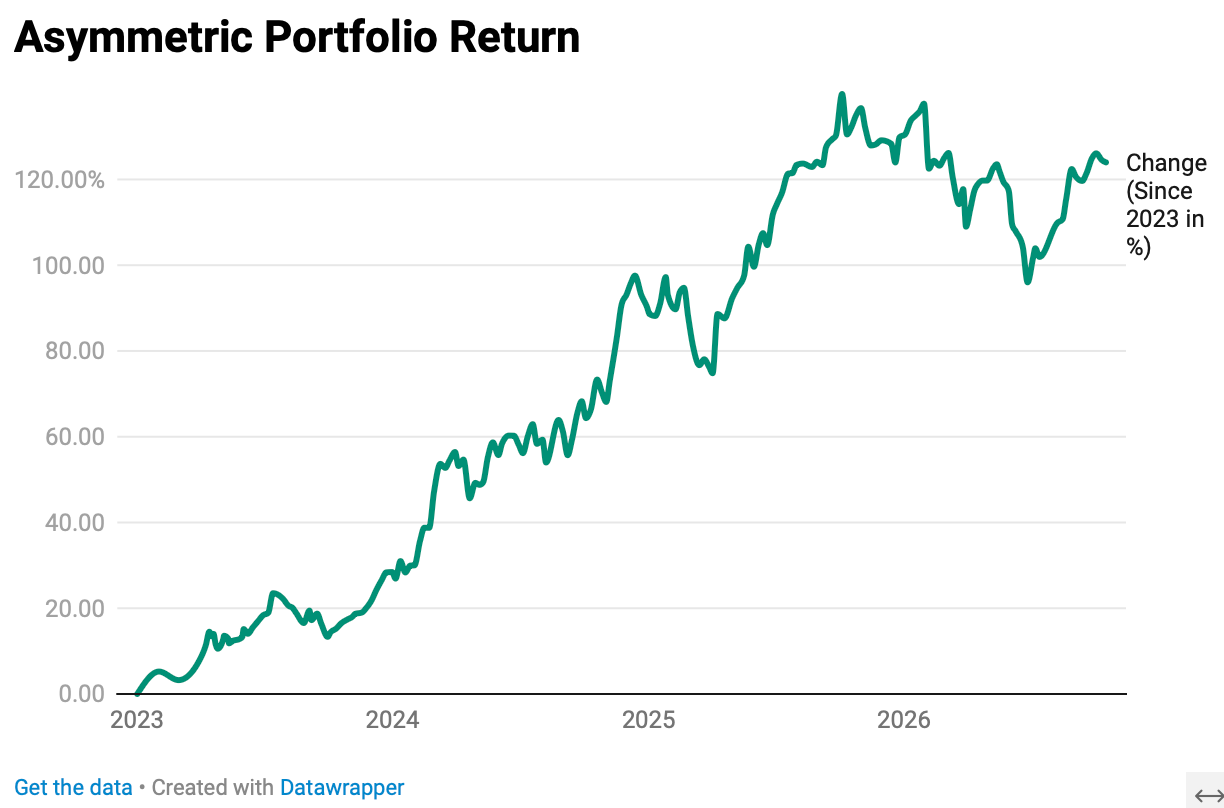
Now our portfolio…
📈 Asymmetric Finance Portfolio
Updated on 16th October