
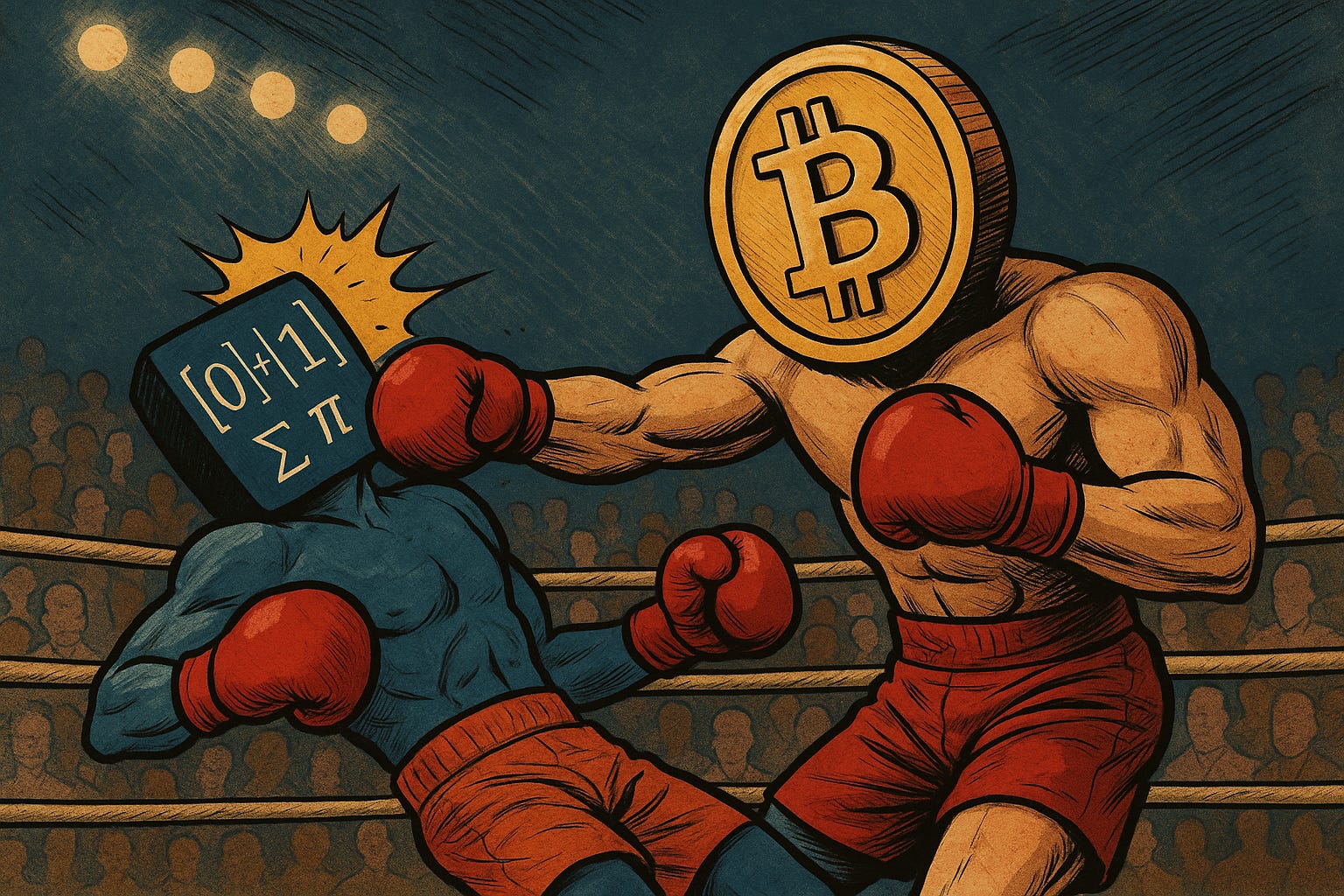
If there’s something that’s been spinning in my head lately, it’s quantum computing.
Not because it’s trendy or hyped, but because I’ve been stuck on a pretty uncomfortable question:
what would happen to Bitcoin and other cryptocurrencies if this technology actually became real, functional, and accessible?
That question has kept me awake a couple of nights.
Not because I think the world is ending, but because if we ever reach that point, the whole financial system, not just crypto, could change completely.
And since I’m a fucking nerd, I’ve read half the internet. I’ve gone through papers, forums, Reddit threads, paranoid theories. And after all that, here’s my verdict. It might be wrong, but at least it’s mine. It’s not copied from anyone or generated by some neutral-sounding AI.
And I’ll also give you a few tips. Some that might make you money or at least stop you from losing it.
The first thing to understand is what quantum computing can and can’t actually break.
A lot of people think “quantum” means “it breaks everything.” It doesn’t.
Bitcoin (and Ethereum, for example) doesn’t rely on a single algorithm. There are two main components:
The SHA-256 hash, used to mine and link blocks.
The ECDSA algorithm, used to sign transactions.
SHA-256 is almost impossible to break, even with a quantum computer.
The real weak spot, if there is one, lies in ECDSA. That’s where Shor’s algorithm comes in, theoretically capable of factoring huge numbers and breaking elliptic-curve cryptography.
But here’s the thing: theory and reality are two very different beasts.
Right now, the most advanced quantum computers (think Google, IBM, or D-Wave) have a few hundred physical qubits at best.
To break ECDSA, we’d need millions.
And not just any qubits, stable, error-corrected, synchronized ones working in perfect parallel.
That’s not something you get in five years.
Or ten.
If we’re being conservative (using Moore’s law loosely) we’re talking about decades.
Some estimates say forty or fifty years. Others, maybe less.
But even the most optimistic projections say at least twenty years before it becomes truly dangerous.
So… can we relax?
For now, yes.
But when ten years ago everyone said this was “centuries away” and now they’re saying “a few decades,” yeah, you start to wonder.
I did.
And that’s when I realized something:
the real risk isn’t just in Bitcoin.
It’s in the entire traditional financial system.
Think about your bank.
Your account, your passwords, your funds, your data.
If a machine could really break ECDSA, Bitcoin’s private keys would be the least of our worries.
Half the world’s passwords would fall in minutes.
Your bank’s “Carlos1234” password wouldn’t last a second.
And the six-digit SMS code you get to confirm transactions would be basically useless.
So if Bitcoin is at risk, the whole system is at risk.
No partial escape.
The good news? Bitcoin can adapt.
In fact, it’s been preparing for this for years.
The base code already allows for upgrades, and people are working on post-quantum algorithms that could replace ECDSA when the time comes.
There are even nodes (like CORE v30) that are integrating changes to make this transition smoother.
And if you look at Bitcoin’s history, it’s not new.
It’s survived bugs, forks, attacks, internal wars.
And in the end, there’s always consensus.
Because Bitcoin’s incentives are perfectly aligned:
no one wants to destroy something that holds their own value.
Actually, if someone could break it, it would probably make more sense to use that power for profit.
Imagine using quantum power to mine faster, optimize computations, or increase rewards.
That would be the logical move.
Spending all that energy just to steal coins and make them worthless? Doesn’t make sense economically.
So my view is simple: we won’t see a direct quantum attack on Bitcoin.
What we’ll see is a slow transition to quantum-resistant algorithms, just like banks, governments, and defense systems will have to do.
Everyone will need to move, not just crypto.
Still, there’s something you can do right now to protect yourself.
And it’s simple.