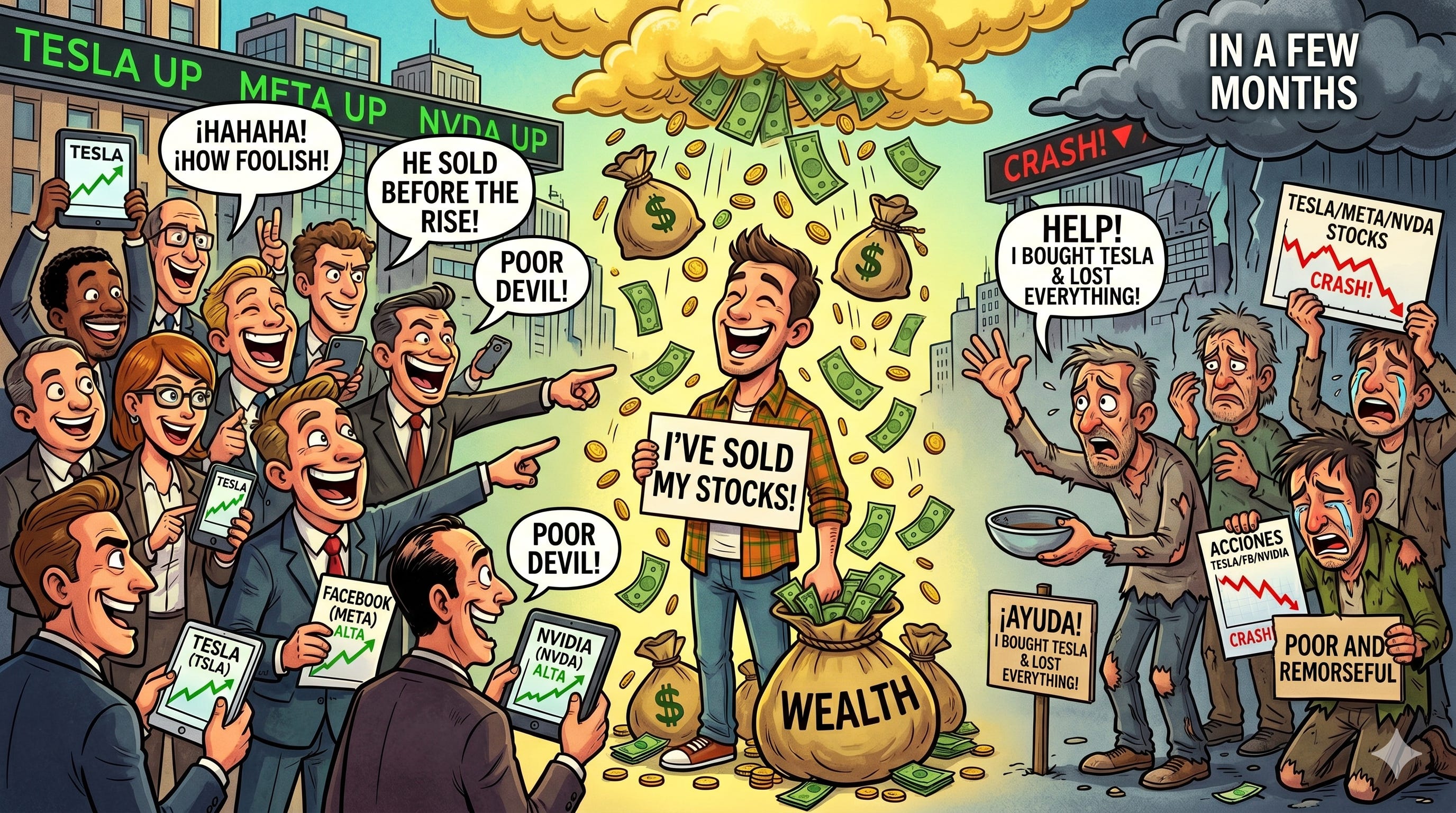
Everyone Criticized Me For Selling My Stocks. Good.
The Real Reason I'm Selling Every Stock I Own
A few weeks ago I published a piece saying I wanted to sell all my stocks.
I got criticized for it.
“But everything’s at all-time highs.”
Exactly. When are you supposed to sell, at the lows? Of course you exit at the highs. And the longer this lasts, the worse the day it ends.
But that’s not the point. Today I want to make one clarification. I’m not going to teach you anything new. I just want us all on the same page.
Let me start with the obvious: I don’t recommend buying stocks.
The moment you buy one, you’re already losing. You pay the spread. And the day you sell, the taxman takes 25% of the gain in the best case. You worked, you were right, and you still hand over a quarter of what you made. By design.
And here’s something almost nobody stops to consider: when you pick an index, you’re rejecting every other one.
Choosing the S&P 500 is not the “neutral,” “passive” option they sold you. It’s a bet. A concentrated one, on large U.S. companies, that you made without thinking. You didn’t choose the index. The one with the most-repeated slogan chose you.
The strategies I share most days don’t depend on any of that. They don’t depend on which index you pick, or even on indices at all. They’re independent, anyone can apply them, and they’re easy. So easy they start working from day one.
Because the real game isn’t picking the right stock. It’s never having to sell it.
When you don’t sell, there’s no gain. When there’s no gain, there’s no tax. You pull liquidity out of your wealth without going through the register. You live off your assets without dismantling them, and without handing a quarter to the taxman every time you need money.
That’s what almost nobody explains to you. And it’s infinitely more efficient than buying the stock of the month hoping to sell it higher.
Here comes the real clarification.
Most people don’t understand what they buy. They DCA into the S&P 500 because they were told it’s gone up 10% a year for a century and that over twenty years it’s impossible to lose. Ask them to name ten of the index’s five hundred companies. They won’t get past five.
In 2007 they swore housing was the safest asset in history. You know how that ended.
And the figure nobody shows you: measured in real money, no index has produced a real return since the year 2000. Divide the S&P 500 by an ounce of gold. In 2000 it was worth five ounces. At the close of 2025, 1.66. Down 67%.
It’s not that the market doesn’t rise. It’s that the ruler you measure it with is made of rubber.
And fewer than 4% of listed companies generate more than 90% of the market’s returns. One in twenty beats Treasury bills. The “diversified” index everyone brags about depends on a handful of names almost no one could point to.
Why does nobody tell you any of this? Because it doesn’t suit them.
It used to be the suited advisor charging you 1-2% over forty years. Today it’s the influencer filming videos about “the opportunity of your life” and earning a commission for every account opened through his TradeRepublic or MyInvestor link. The face changes. The business is the same: profiting from the fact that you don’t understand what you’re doing.
And that’s not their fault. It’s yours.
Investing isn’t for those who want the easy route, or for those looking for the answer handed to them. It’s for those who put in the time to understand what they buy and, above all, to understand how to take their money out without it being eaten alive by taxes along the way.
That’s what I teach. Not how to buy stocks. How to pull your money out of confiscation’s reach. Because no word echoes louder in my head than one: freedom.
The day you understand it, you stop depending on anyone. And when you depend on no one, there’s no longer anyone who can take advantage of you.
That’s all I wanted to make clear today.


