
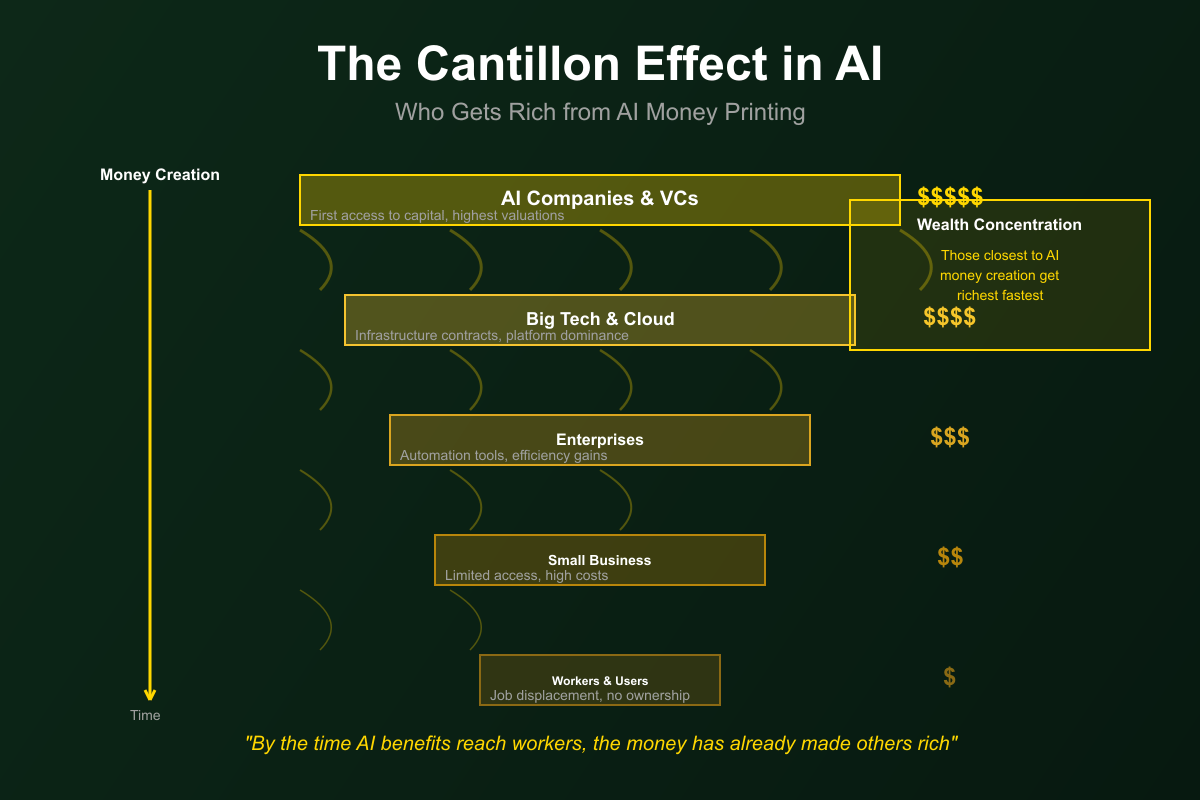
There are theories taught in class. Theories quoted on podcasts. And theories that, for whatever reason, stay buried under layers of noise while the entire world lives them every single day.
The Cantillon Effect is the most forgotten of them all.
I wrote about it some time ago from a practical angle: whoever receives the money first buys cheaper, whoever receives it last buys the inflation. Simple. Almost childlike in its logic. But I came back to it because I stumbled on a recent Sandmark report that puts the numbers on the table, and the numbers are so violent that it’s hard to understand how we’re still having conversations about dividends and sector rotation without addressing this first.
Between 1990 and 2026, the U.S. M2 money supply rose from $3.18 trillion to over $22.4 trillion. A 604% increase. Over the same period, the net worth of the top 0.1% of households went from $1.7 trillion to $24.87 trillion. A 1,363% increase. The bottom 50% rose 507%, from $0.7 to $4.25 trillion. You don’t need to be a quant. The slope is the slope. Those closest to the tap captured a disproportionate fraction of everything that came out of it.
And there’s a data point people tend to skip: in 2022, 93% of U.S. equity market value belonged to the top 10%. It’s not that the market hasn’t gone up. It’s that when it goes up, it goes up for them.
This is where the typical portfolio conversation becomes absurd. Most retail investors are obsessed with picking the right ticker. The winning sector. Whether the S&P will beat MSCI World this year or if China will rebound. But the return you get from picking well inside conventional financial assets is marginal compared to the return you get from standing at the beginning of the flow of new money, instead of at the end of it.
The Cantillon Effect is not an academic curiosity. It is the architecture of modern wealth inequality.
Let’s do the numerical exercise nobody wants to do.
Imagine two investors. Both hold 200,000 euros in Bitcoin today. Bitcoin at, let’s say, 100,000 dollars.
Investor A: follows the classic playbook. Keeps his two bitcoins. Adds to the market as he saves from his salary. Collects dividends from a parallel 100,000 euro equity portfolio paying 4% net, roughly 4,000 euros a year. Lives quietly.
Investor B: borrows against his bitcoins. 100,000 euros at 6% annual interest against his collateral. With that money he buys another bitcoin. He now holds three bitcoins instead of two. The loan interest costs him 6,000 euros a year, but he services it with a rolling credit line or cashflow from other sources. He never sells. He never pays tax.
Ten years later, let’s assume Bitcoin quadruples. Conservative for anyone who understands the thesis.
Investor A holds two bitcoins worth 800,000 euros, plus the dividend portfolio. He has collected 40,000 euros in dividends over the decade, of which, after tax, he has kept roughly 30,000. Total net worth: around 930,000 euros.
Investor B holds three bitcoins worth 1.2 million. His accumulated debt with capitalized interest is around 180,000 euros. Net worth: over one million. And more importantly: zero taxable events. Zero sales. Zero rotation. The principal remains intact and keeps compounding.
The difference between the two is not the asset. It’s the speed at which they got positioned. Investor B advanced capital that A never had the discipline or the access to advance. He bought earlier. He bought more. And while A was collecting 4,000 euros a year for groceries, B was building a position four times larger in absolute terms with the same initial collateral base.
That is the Cantillon Effect at household scale. You don’t need to be a central bank to operate it. You just need solid collateral and a lender willing to accept it.
The problem with most retail portfolios is that they’re designed not to lose, not to advance. The dividend makes you feel you’re winning while the leveraged buyer next to you is multiplying. The indexed ETF gives you the comfort of not making decisions while the system rewards precisely those who make them with conviction. Tax optimization inside a retirement account saves you a few basis points while the one who never sold saved himself the entire taxable event.
And here’s the uncomfortable part: the system is not going to change. The monetary tap will stay open as long as there’s sovereign debt to refinance, which is to say forever within any living investor’s horizon. The question is not whether the Cantillon Effect will keep existing. The question is which side of it you’re going to be on every time they open the floodgates.
The vast majority of retail investors will stay on the wrong side. Not from lack of information, but from lack of structure. You need collateral to borrow. You need an asset the system recognizes as solid. And you need to accept, emotionally, that well-structured debt against an appreciating asset is the most powerful tool available to an individual.
What separates Investor A from Investor B is not the initial capital. It’s the understanding that collecting dividends for the grocery run is not the goal. It’s a consolation.
The goal is to stand closer to the tap. Always.
Now our portfolio…