

This morning I uploaded a new video: Bitcoin Crashed 54%. One Seat Still Got PAID 12%.
In 13 minutes you’ll learn why Strategy’s 12% paper (STRC) is falling again, whether it’s a gift or a trap, and what this crash means for Bitcoin over the next ten years.
I’ve been talking about permanent portfolios for weeks now.
About Harry Browne. About why someone who died in 2006 designed something that ages better than almost anything they’ll sell you at a bank branch today.
And the same question has come back to my inbox so many times that I recognise it before I open the email.
“Fine, Carlos. I get it. But what happens in each scenario? What happens to me?”
It’s the right question. Because Browne’s idea was never a portfolio. It was a confession: nobody knows which decade they’re going to live through. You build for all four, or you build for the one you find most comfortable to imagine.
Which is usually the same one you’ve been living in for the last fifteen years.
So let’s actually do the exercise. Four scenarios. Four real decades that already happened. And what happened to the people who were inside them.
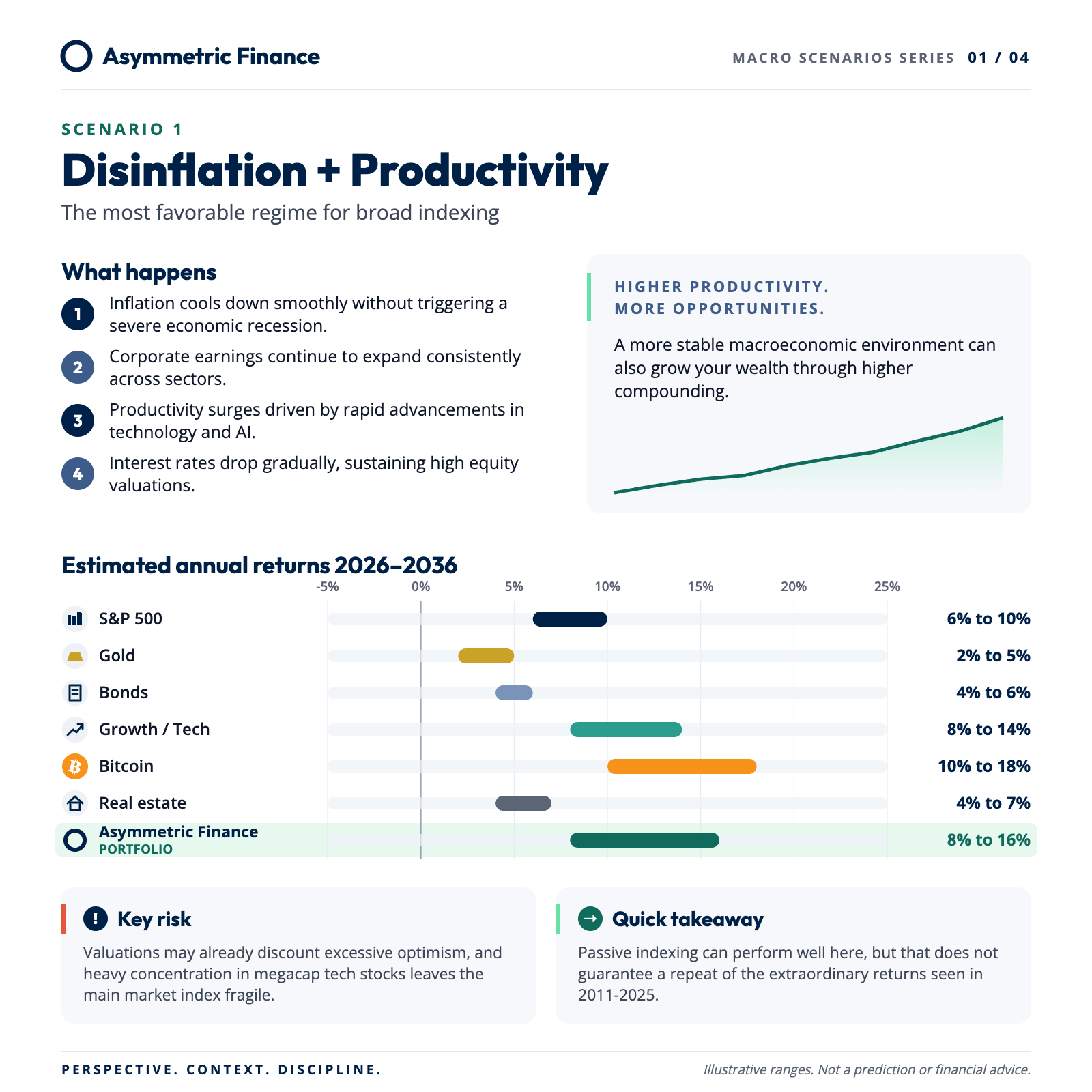
In the first scenario everything works out. Inflation cools without breaking anything. Rates ease slowly. AI productivity turns into real earnings instead of PowerPoint slides. This is 1995-1999. This is 2013-2019. The bubble doesn’t burst: it gets digested.
Here the loser isn’t the one who gets the analysis wrong. It’s the one who protects himself too much.
I know that person. He left the market in 2012 because the euro was falling apart. Moved into gold and cash, waiting for the collapse every headline was promising. He was right about the diagnosis and wrong about the decade. Ten years later he was still right, and sitting on half the wealth he would have had if he’d done absolutely nothing.
The cost of caution never shows up on a statement. That’s why nobody measures it.
But notice something uncomfortable here, because it’s the part nobody mentions about this scenario. Even in the best of the four possible worlds, the index does 6-10% a year.
Not the 14% of the last decade.
Which means the good scenario is already worse than what most people are extrapolating in their spreadsheet. And it arrives concentrated: half a dozen technology companies carrying the entire index. That isn’t diversification. It’s a sector bet wearing the name of a global fund.
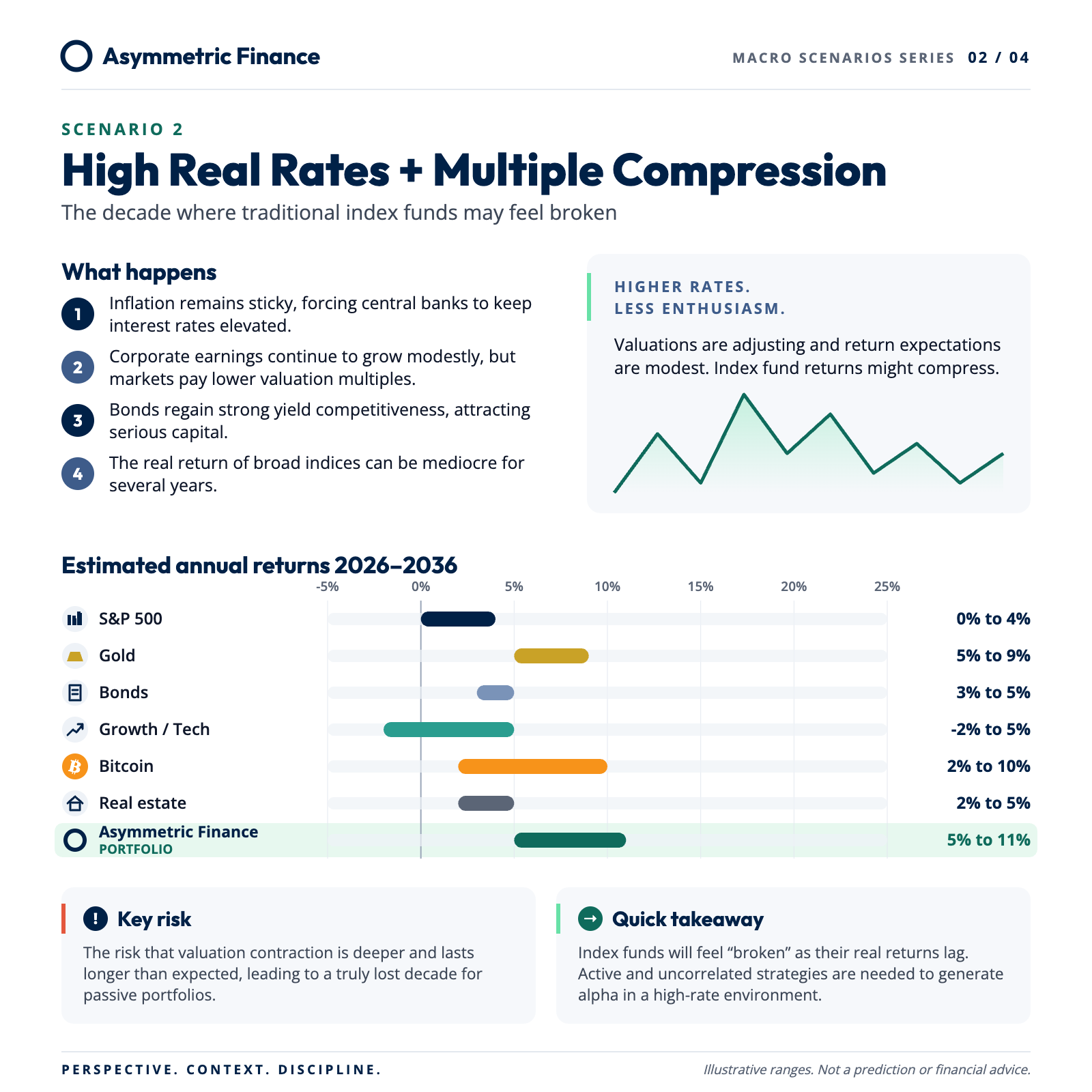
In the second scenario the economy does fine and the market doesn’t. Earnings grow. Multiples compress. You pay less for every euro of profit than you did before, year after year, and the index sits still while the business improves.
This is 1966-1982 in the United States. It’s Japan after 1990. It’s the S&P 500 between 2000 and 2013, thirteen years to get back to where you started.
It’s also the story of the Nifty Fifty. The fifty best companies in the world. Coca-Cola, IBM, Xerox. Nobody argued about their quality. Nobody argues about Nvidia’s quality today. The problem was never the business.
It was the entry price.
The people who bought those companies in 1972 were completely right about the businesses and spent a decade and a half getting their money back. Many never did. They sold along the way, exhausted, convinced the system was broken. And the system wasn’t broken: they had simply paid fifteen years of the future up front.
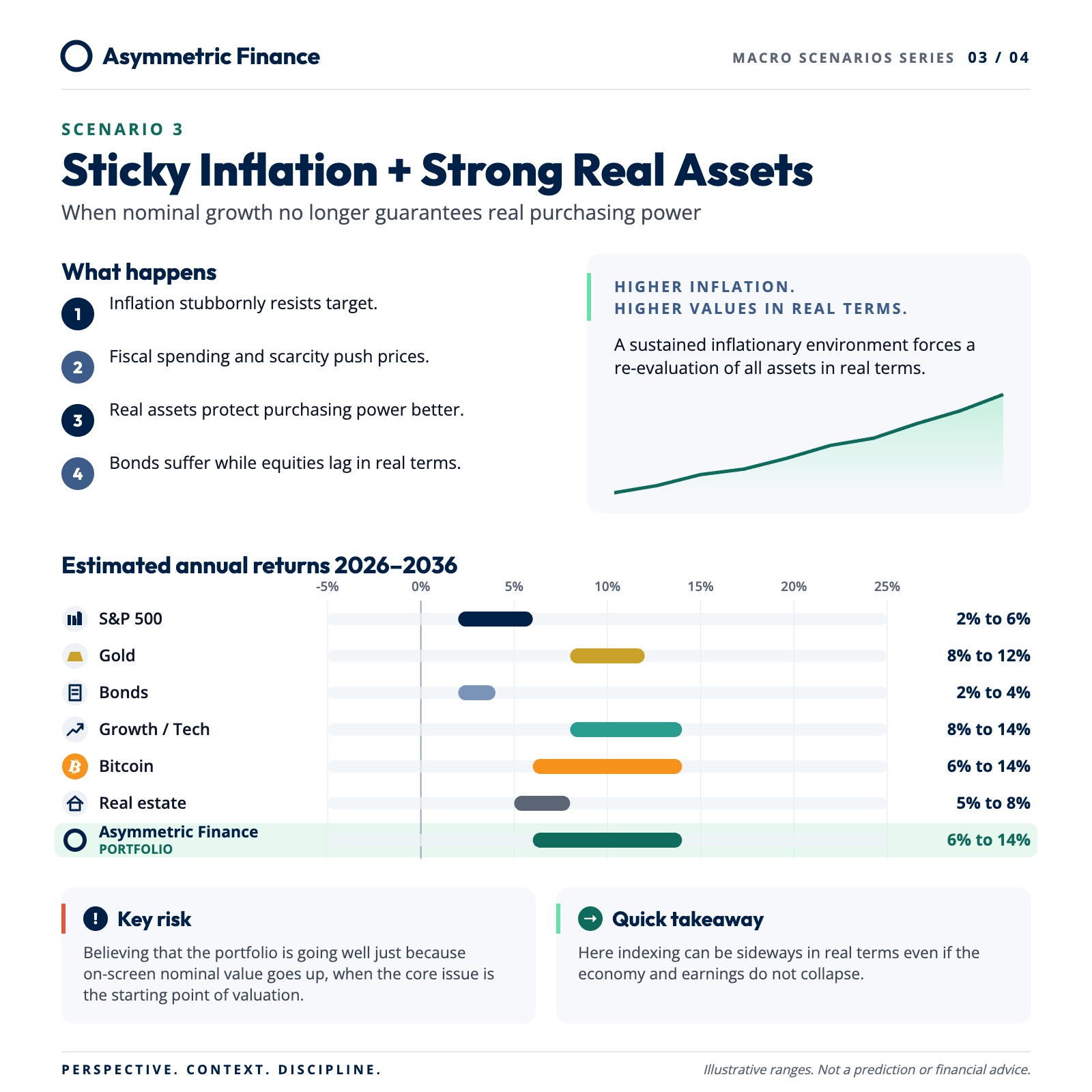
In the third scenario inflation doesn’t leave. It settles in. Not at 15%, which frightens people into action, but at 4-5%, which bores them into sleep. Public spending doesn’t get corrected because politically it can’t be corrected. Real assets protect you. Bonds bleed. The market rises in nominal terms and goes nowhere in purchasing power.
This is the seventies, without the drama.
And here is the person who interests me most out of all four stories: the saver who did everything right. Worked. Stayed out of debt. Put money aside. Checked the balance every year and the number was bigger than the year before.
He never saw a red number.
And he lost half of what he had.
That’s the perfect robbery. No crash, no panic, no front page. Just a strange kind of fatigue at the supermarket, where you can’t work out why your life costs what it costs when you earn more than you used to.
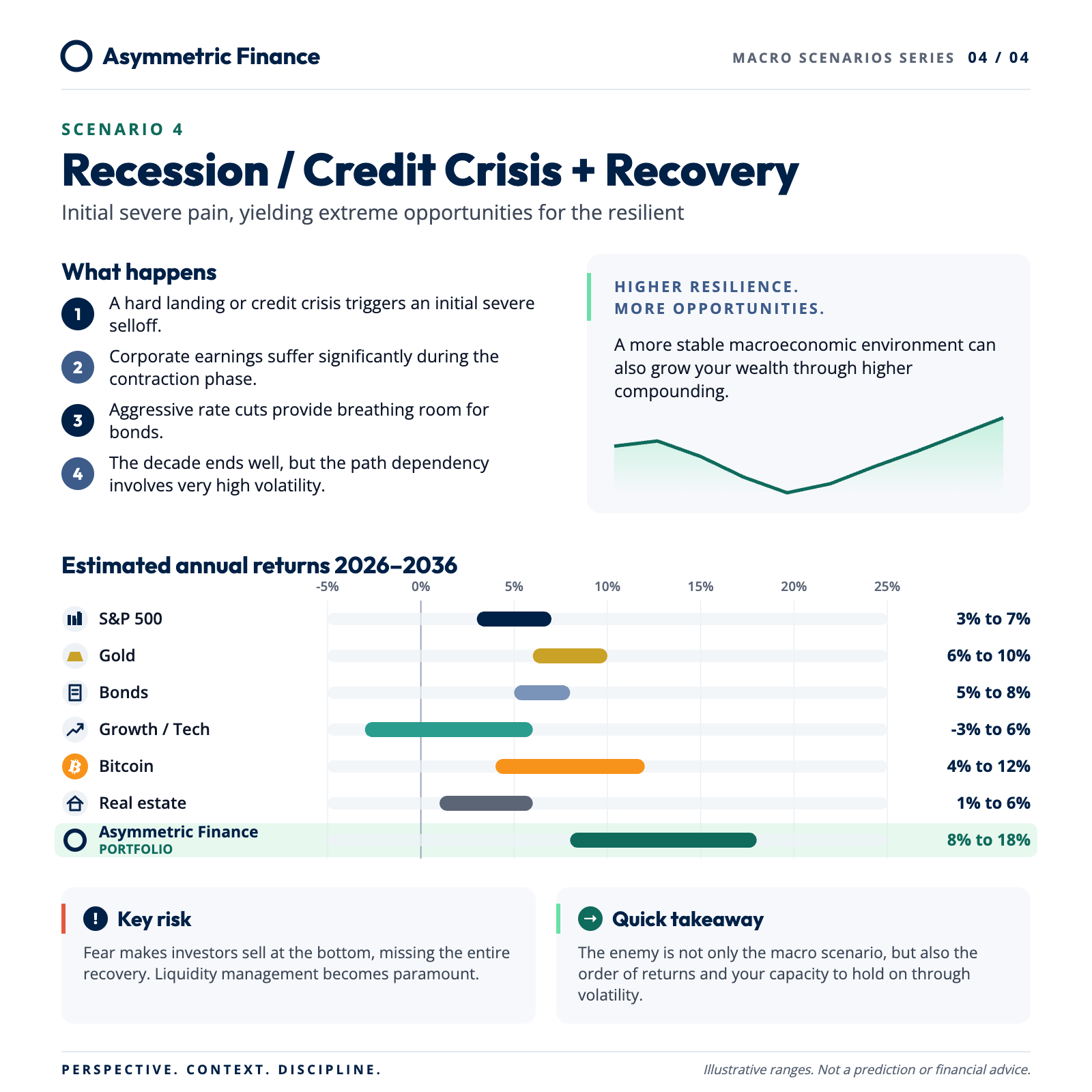
In the fourth scenario the real blow lands. Hard landing, credit crisis, forced selling, everything correlated to the downside. And then aggressive rate cuts and a violent recovery. The decade ends well.
This is 2008-2009. And statistically it’s the best ten-year scenario of the four, for whoever holds on.
The problem is that almost nobody holds on.
March 2009 wasn’t an analytical failure. It was a liquidity failure and a stomach failure. People sold at the bottom not because they’d stopped believing in the recovery, but because they needed the money that month. The market didn’t force them out. Their own cash structure did.
In this scenario your enemy isn’t the macro. It’s the order in which the returns arrive and your capacity to stay alive while they do.
Four scenarios. Four different ways to lose. And only one of them looks anything like what people picture when they think about losing money.
Now let me tell you which one I think we’re getting.
This might save you several thousand euros.