

The other day I got stuck on a Reddit thread.
People with $20 or $30 million in net worth explaining what they actually spend every year. I expected cars, houses, watches. And there is some of that, sure. But what came up again and again, in almost every reply, was something else: travel. Whole weeks with the family in specific places. Experiences you can’t repeat. People who no longer need anything and who, when they can buy whatever they want, buy time with their own in places they won’t forget.
I found it curious. Then I realised it wasn’t curious at all.
Around the same time Anthropic, the company behind Claude, filed its prospectus to go public. By the time you read this it may already be trading, or not. It doesn’t matter, because the interesting part is the document itself.
More than 300 pages, and about 94 of them are risk factors
More than 90 pages in which the company explains everything that can go wrong: it depends on a handful of large customers, compute eats 55% of revenue, its purchase commitments exceed $895 billion and it expects to keep losing money for a good while. In the first half of 2026 it reported a net loss of $80.7 billion. Most of it is an accounting charge on its convertible notes, fine, but the message is what it is.
And here is the strange part.
That same company generates more than $6.6 million in revenue per employee. Only Nvidia does better, around $7.2 million. Nobody in the history of technology has grown this fast with this few people. And still, with those numbers, the filing warns you it can’t guarantee it will ever turn a profit.
When a machine that produces $6.6 million per head can’t make money, the question isn’t whether the business is good. The question is who keeps the margin. And the answer sits at the very top of the chain: the people who make the chips.
There is a pattern I find hard to ignore.
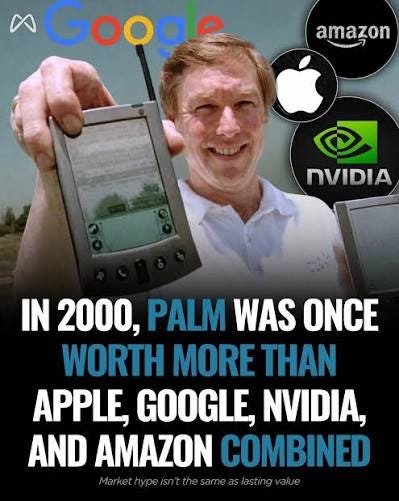
Palm went public in March 2000, the week the Nasdaq peaked. Blackstone in June 2007, months before everything fell apart.
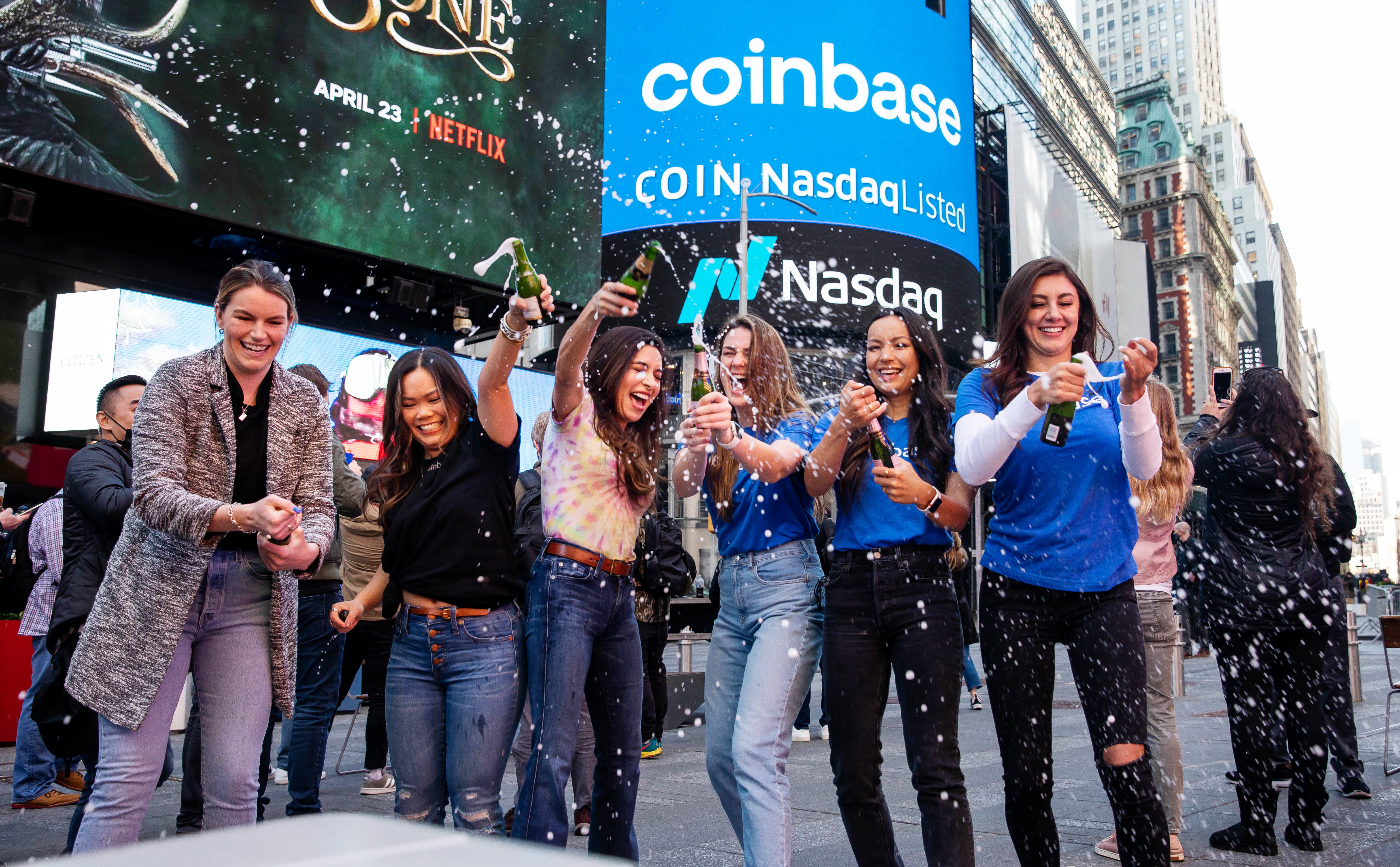
Coinbase in April 2021 and Rivian in November that same year, right before the 2022 we all remember. It isn’t that the IPO causes the crash. It’s that the most desired company of the moment lists exactly when the market is willing to pay anything, and that usually coincides with the end. I wrote before about how cycles changed with continuous refinancing, and this fits: the end comes when someone puts a price on the euphoria.
Is Anthropic that company? I don’t know. Nobody does. What I do see is that it doesn’t look good: a company with 94 pages of risks, enormous losses and commitments close to a trillion dollars coming to market with the Nasdaq near record highs and rates going up. If you want my take on the bubble we are in, it’s there.
But let me tell you something that doesn’t fit that picture.
I use Claude every day. It has changed how I work, how I write, how I run my companies. And what I see in the people around me is always the same: once they start using it they don’t stop, they just level up. That isn’t a bubble of expectations, it’s real usage. Amazon went public in 1997, dropped more than 90% in 2000 and 2001, and today you know what it is. Maybe Anthropic is this cycle’s Amazon: the right company, at the wrong time, at the wrong price.
Both things can be true at once. We may be at the end of a cycle and this technology may change everything we know. In fact, both being true is the normal outcome.
And that brings me back to the Reddit thread.
If productivity goes to infinity, if a company of 5,000 people can bill what used to take 100,000, everything that can be produced gets cheaper. Software, analysis, design, knowledge. All of it drops in price because the machine does it for almost nothing. But some things can’t be produced.
A week on an island with your kids. A meal with people you love. A trip you can only make once. AI doesn’t multiply that. If anything, it makes it scarcer relative to everything else. It’s what I saw when I wrote about what the super-rich prefer, a Picasso or Bitcoin: what can’t be copied is what ends up going up.
The people with $30 million have already understood this, even if they don’t put it that way. When you can buy anything, you buy the one thing the machine doesn’t make.
So my conclusion isn’t to sell or buy Anthropic. It’s simpler than that.
If the cycle ends, I want liquidity to attack the dislocation
If it doesn’t, I want exposure to what is truly scarce: hard money nobody can print and experiences nobody can replicate. And in both scenarios, I want my life not to depend on guessing which one we get. That is what never giving up optionality is about.
That is asymmetry. Not knowing what will happen, and having built something that wins either way.